Upside Down Cross Meaning: What the Cross of St Peter Really Says
TL;DR – An upside down cross is the Cross of Saint Peter. Tradition says Peter asked to be crucified head down because he felt unworthy to die the same way as Christ. For nineteen centuries it has read as humility, martyrdom and papal authority, never as a rejection of the faith. The sinister reading is recent: horror films, metal album art and internet folklore did that work, not the Church.
Turn a cross over and something in a room shifts. People notice, someone usually comments, and the question lands fast: is that a bad sign? The answer sits in the first century, not in a horror movie. The inverted cross belongs to Peter, the fisherman who became the rock of the early Church, and it has carried the same meaning for two thousand years: a man who thought himself unworthy of dying the way his teacher died.
This guide walks through the origin of the symbol, what it means in Catholic and Protestant contexts, where the modern fear of it came from, and how to wear an inverted cross without spending every conversation defending it. If you already know the shape you want, our upside down cross collection is a shortcut to the pieces themselves.
The Short Answer: An Inverted Cross Is Peter’s Cross
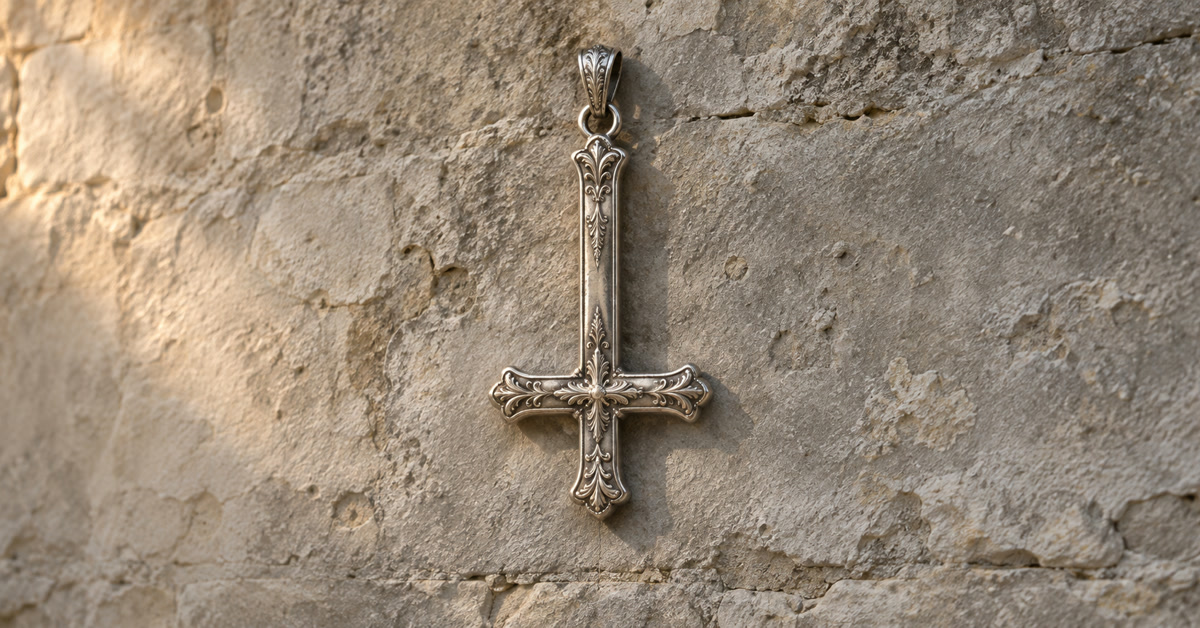
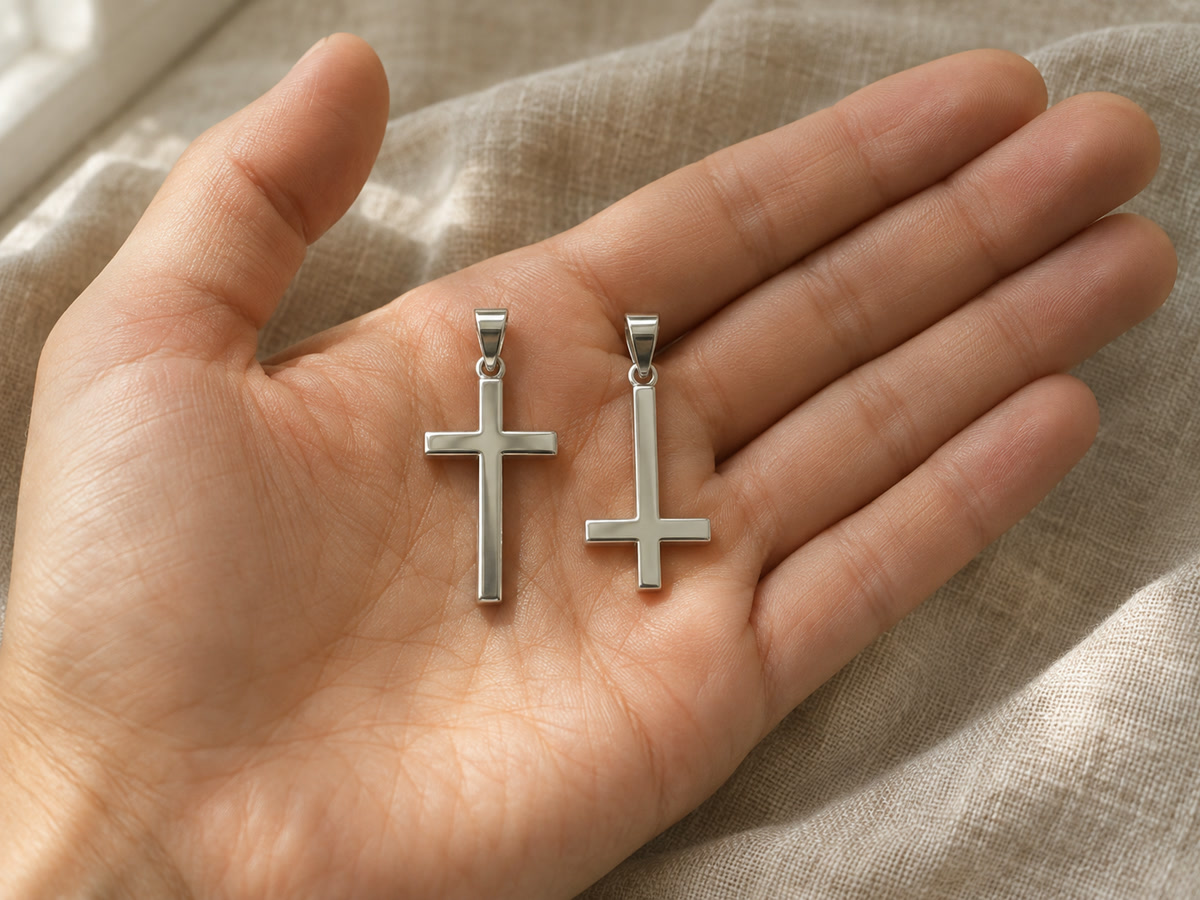
A standard Latin cross puts the long arm at the bottom. Flip it and the long arm points down while the short crossbar sits near the top. That single flip is the whole symbol. Latin Christians call it the Cross of Saint Peter, Crux inversa, or Peter’s cross, and it commemorates his crucifixion in Rome under Nero, around the year 64.
Two things follow from that, and both matter for how the symbol reads today. First, the inverted cross is a Christian cross. It sits within the tradition, not against it. Second, its meaning comes from a person and an event, not from a shape that carries evil on its own. A shape is only what a community agrees it means, and the community that invented this one agreed on humility.
Peter’s Request, According to Tradition
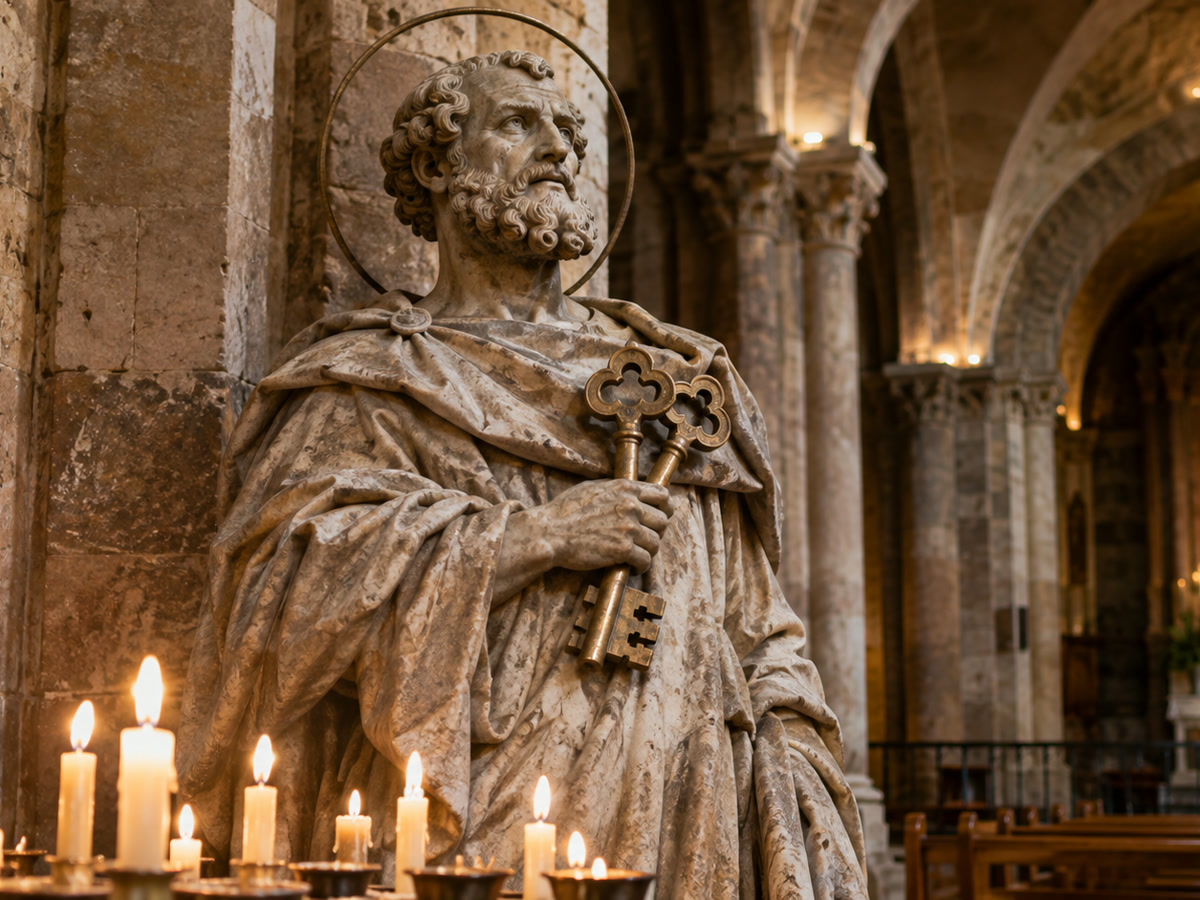
The story comes from the Acts of Peter, a second century text that never entered the biblical canon but shaped Christian memory deeply. Fleeing Rome during Nero’s persecution, Peter meets Christ on the Appian Way and asks where he is going. The answer sends him back. When the soldiers finally take him, Peter requests to be crucified upside down. His reason, as the tradition preserves it: he did not deserve to die in the same posture as his Lord.
Early writers repeat the detail. Origen mentions it in the third century, and Eusebius passes it along in his church history. Tertullian already treats Peter’s death in Rome as settled fact. Whether you read the dialogue on the road as literal history or as theological storytelling, the point the early Church kept repeating is the same: the inverted posture was an act of self lowering, not of defiance.
Why the Symbol Stuck
Rome executed thousands of people by crucifixion. Only one of them is remembered for asking to be hung the other way up, and that memory survived because Peter’s authority mattered to the communities that came after him. The see of Rome built its claim on his name. A symbol that pointed to his death and his humility became useful in exactly the places where his successor’s authority was being argued.
By the Renaissance the inverted cross turns up in papal commissions and in devotional art around the martyrdom of Peter. It is not everywhere, and it never became as popular as the plain cross or the crucifix, but it was never treated as suspect either. To a sixteenth century Catholic, an upside down cross on a wall said Rome and Peter. Nothing else.
What the Inverted Cross Means to the People Who Wear It
Meaning in jewelry is rarely abstract. People wear a symbol because it names something they are living through. Across Catholic, Anglican and Orthodox communities, and increasingly among young Christians with no strong denominational label, the inverted cross tends to land on three ideas.
Humility Before a Standard You Cannot Meet
Peter’s request is the model. He followed Christ, he failed him three times in a courtyard, he was restored, and at the end he refused the privilege of an identical death. An inverted cross says something close to that: I am not the center of this story. For people who find the triumphant cross a little too easy, the flipped version keeps the harder half of the faith visible.
The Keys, the Rock, and Church Authority
In Catholic settings the symbol is tied to the papacy. Matthew 16 gives Peter the keys and the name Rock, and the bishops of Rome built their office on that passage. An inverted cross on a chasuble, a banner or a piece of devotional silver reads as a statement about where authority sits. If you want the full history of how the Roman see assembled that claim, the guide to the major cross types puts it in context next to the Orthodox and Reformation traditions.
Discipleship Under Pressure
The third reading is the one that sells most pieces today, and it is not cynical. Peter’s cross is a cross worn by someone whose faith cost him something. Christians in Nigeria, Iraq, Pakistan and China wear it for that reason. So do people in comfortable countries who want a reminder that following Christ is not a lifestyle accessory. The shape does the work a sentence would take too long to do.
Where the Satanic Reading Came From
The idea that an upside down cross signals devil worship is younger than the electric guitar. It hardened in the second half of the twentieth century, built from three streams that fed each other.
- Horror cinema. The Exorcist (1973) and the wave of possession films that followed used the inverted cross as shorthand for desecration. A prop department needed one image that read as wrong in half a second, and flipping a familiar object does that better than inventing a new one.
- Metal and goth imagery. From the late 1970s onward, bands borrowed Catholic and occult symbols for shock value. The inverted cross was free to use, instantly legible on a poster, and offensive to exactly the audience the music wanted to unsettle.
- Internet folklore. Lists of “secret satanic symbols” circulate for decades without sourcing. Once a claim about a symbol appears in a hundred low quality articles, it starts to feel like common knowledge, even when the documented history says the opposite.
What did not happen is a doctrinal shift. No council, no catechism and no major denomination has ever taught that an inverted cross is satanic. The reading is cultural, imported from entertainment, and it exists in parallel with a much older use that never stopped.
Judging a Specific Piece
When you look at an inverted cross in the wild, the surrounding design tells you almost everything. A five pointed star, a goat head, a pentagram, an inverted pentagram inside a circle: those belong to modern occult iconography with its own documented history. An inverted cross set with a key motif, the letters INRI, a haloed heart, gothic tracery or a baroque scroll pattern sits in a Christian visual language that predates the horror film by centuries. Our own inverted pieces read that way on purpose, and the cross versus crucifix breakdown is useful if you also want to know what the corpus adds.
Two Words That Get Confused
The satanic inverted cross usually has a reversed orientation as a deliberate insult: the figure of Christ, if present, hangs upside down to mock the crucifixion. Peter’s cross is normally just the bare cross, no corpus, flipped to honour a martyr. Same geometry, opposite intent, and the presence or absence of the body is often the fastest visual clue.
Wearing One: Metal, Scale and Setting
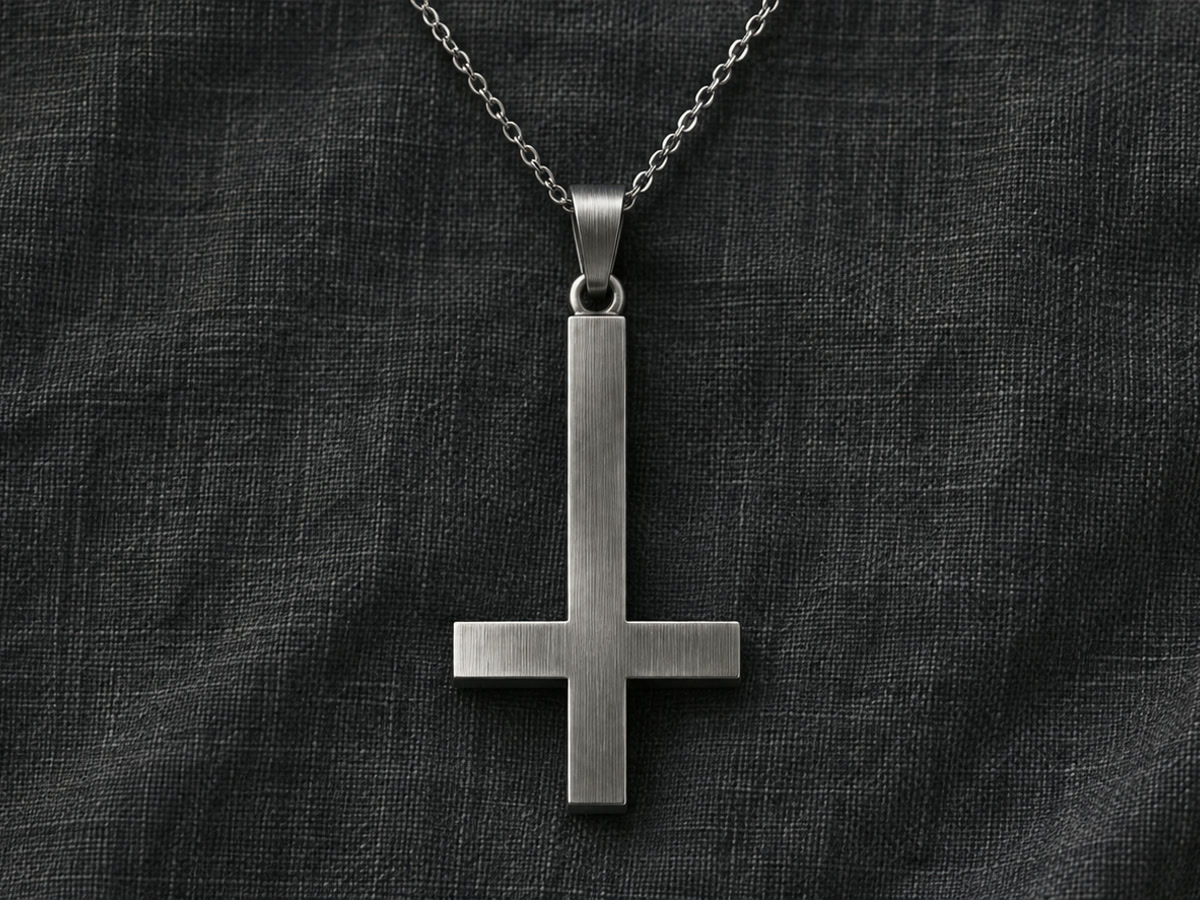
An inverted cross is a louder shape than an upright one, because the eye expects the long arm on top and gets it on the bottom. That expectation is the reason the pendant works, and it is also the reason scale matters. A small inverted cross reads as a personal detail. A large one reads as a statement and invites conversation you may not want at work.
What It Pairs With
The vertical emphasis makes this shape forgiving with necklines. Crew necks and turtlenecks balance it. A V neck already points down, so an inverted cross there doubles the line and can look unresolved; if you want it with a V, go smaller and let the chain sit high. On men the piece tends to sit best on a 20 to 22 inch chain over a plain tee or a knit, which is why our inverted designs ship with a box chain in that range. Layering works too, provided the second piece is a different length and a lighter gauge, otherwise two long verticals fight each other.
Metals That Hold Up
Everyday wear punishes jewelry. Stainless steel and PVD coated steel take sweat, chlorine and friction without much complaint, which is why most inverted cross designs on the market are made that way. Sterling silver is softer, brighter and heavier in the hand, and it needs a polish every few weeks. The trade off and the price gap are covered properly in the sterling silver versus stainless steel comparison. If you go the silver route, keep the five at home cleaning methods handy, since recessed detail on an inverted piece traps tarnish faster than a flat surface.
Inverted and geometric cross designs :


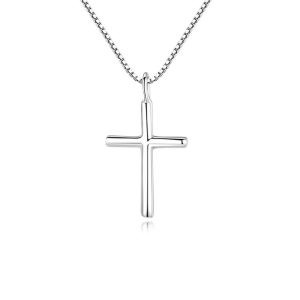
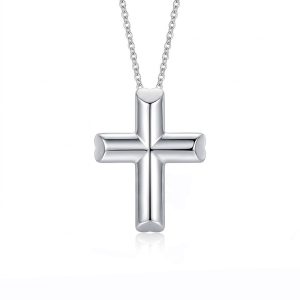
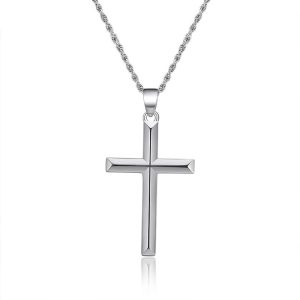
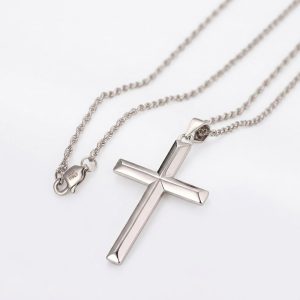
Or a classic silver cross, if you prefer the traditional shape :


Peter’s Cross, Papal Cross, Upside Down Crucifix: Sorting the Terms
Shopping for this symbol means meeting four or five names that sound interchangeable and are not. A short glossary saves a return.
The Papal Cross Is Not an Inverted Cross
The papal cross carries three horizontal bars of decreasing length, stacked with the longest at the bottom. It marks the office of the pope and appears in processions and in heraldry. It is vertical in the normal sense and has nothing to do with Peter’s posture. Confusing the two is common, and it is the reason some listings label a three bar piece as an inverted cross when it is a papal or archiepiscopal design.
The Cross of Lorraine, the Tau and the X
The Cross of Lorraine has two bars and sits upright. The Tau cross is a T with no upper arm. The X shaped decussate cross belongs to Saint Andrew, who according to tradition was crucified on that pattern rather than upside down. Peter’s cross is the only one of the group defined by rotation of a Latin cross, which is why photographs can be misleading: a pendant photographed sideways or hung from a wrong loop can look inverted when it is not.
Which One Is “Upside Down Crucifix”
An upside down crucifix, meaning a corpus attached to an inverted beam, is rare as a devotional object and common as a film prop. Historically the inverted cross of Peter is a bare cross. If you are buying a piece with a figure and it hangs upside down, treat the seller’s description with some suspicion until you see the object, because the combination was not part of the older tradition. For the wider family of forms and their meanings, the twelve types of crosses overview is the fastest orientation.
Related Cross Guides
Each cross type carries its own history and its own visual grammar. These guides go deeper on the forms that come up most often when people are choosing a piece.