Cross Size Guide: How Big Should Your Cross Be?
TL;DR – Most crosses on the market fall between 0.4 and 2.5 inches tall, and that half inch to two inch range is where almost every decision lives. Under 0.9 inch reads delicate and works on small frames or for layering. Around 1 to 1.4 inches is the safest everyday size for adults. Above 1.5 inches becomes a statement piece that needs a shorter, thicker chain to sit right. Measure height from the top loop to the bottom tip, check it against the neckline you wear most, and size up one step if the cross will be a gift.
Most people shop for a cross the way they shop for a t-shirt: they pick the shape and the metal, then guess at the size. Then it arrives, and something is off. A cross you pictured as bold turns out to be a delicate little mark near the collarbone, or one you expected to sit neatly in a neckline covers half your chest. Nothing is wrong with the piece. The proportions were never checked.
This guide fixes that. It gives you real measurements, the height ranges that actually exist on the market, how each one reads on a body, and the small set of rules that turn a guess into a decision. If you already know you want a specific look, you can browse our cross collection with the numbers in hand and skip straight to the section you need.
Why Size Does More Work Than You Think
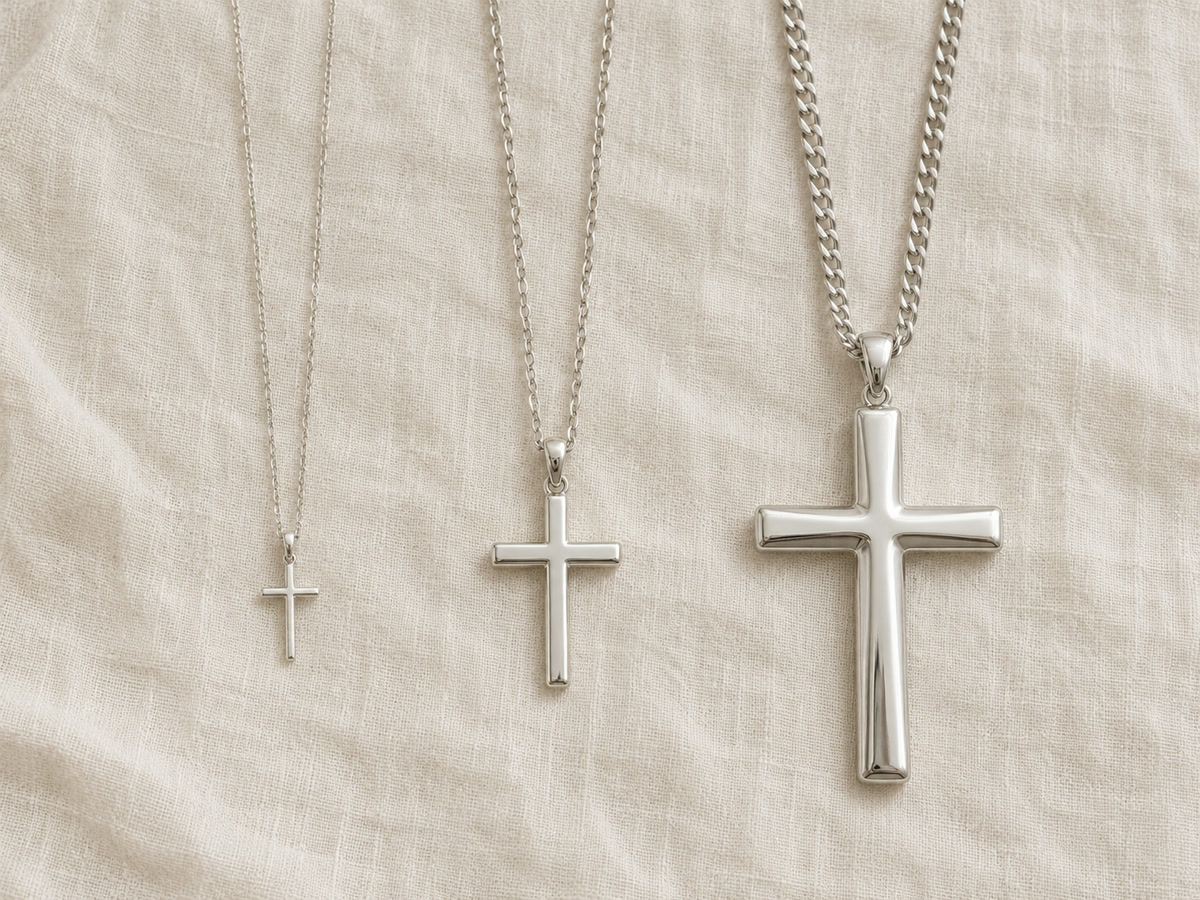
A cross is a shape built from two straight lines, which means there is no volume to soften it. There is no curve, no gemstone spread, no drape. Every proportion is visible at a glance, so a difference of a quarter inch changes the entire impression. A 0.5 inch cross looks like a punctuation mark. A 1.2 inch cross of the exact same design looks like a deliberate declaration.
Size also decides how the piece behaves. Small crosses stay flat against the skin and rarely flip, because there is not enough surface for gravity and movement to catch. Large crosses have a wide arm span, so they tilt, swing, and catch on fabric. That is why the same chain length that feels invisible with a dainty cross can feel restless with a large one.
And size sets the metal budget. A 1.5 inch solid sterling piece carries roughly four to five times the silver of a 0.6 inch piece of the same thickness. Two crosses priced far apart are often not a markup story at all. They are simply different amounts of material.
The Five Size Bands You Will Actually Find
Sellers describe size badly. Some quote the height, some the width, some the total drop including the loop, and plenty quote nothing at all. Ignore the adjectives for a moment. In practice, crosses sold today cluster into five bands, and once you know which band you want, the shopping gets fast.
Band 1: Under 0.6 Inch, the Whisper Size
Roughly the size of a pea. This is the zone of first pieces, delicate layering, and gifts for teenagers. It almost disappears under a collar and reads as a small glint rather than a symbol you can identify from across a room. It is also the most comfortable size to sleep and shower in, and the hardest to break because there is so little to catch on anything.
Band 2: 0.6 to 0.9 Inch, the Everyday Size
The default for most women buying a single cross to wear daily. Big enough to be recognised at conversation distance, small enough to stay out of the way. On a petite frame it reads as a full, finished piece. On a tall or broad frame it can look undersized, which is the single most common disappointment in this band.
Band 3: 1 to 1.4 Inch, the Confident Middle
The safest all-round choice for adults, and the range where most men’s pieces begin. It holds its own against a t-shirt, a shirt collar, or a light sweater without dominating. If you are buying blind for someone whose taste you are unsure of, aim here. It flatters nearly everyone and rarely feels either fussy or showy.
Band 4: 1.5 to 2 Inch, the Statement
This is where a cross becomes the focal point of an outfit. It needs room around it, which usually means a plain neckline, and it needs a shorter chain so the piece sits high on the chest instead of swinging at the sternum. On larger frames it reads balanced. On very small frames it can overwhelm unless the cross is flat and lightweight rather than chunky.
Band 5: Over 2 Inch, Bold and Unmissable
Statement territory, frequently worn over clothing rather than against the skin. Weight becomes the real issue here. A 2.5 inch solid cross can run past 20 grams, which is enough to pull a fine chain and stretch it over months. Anything in this band should come on a thicker chain, a cord, or a leather strap, and should be judged on how it lies, not just how it looks flat on a table.
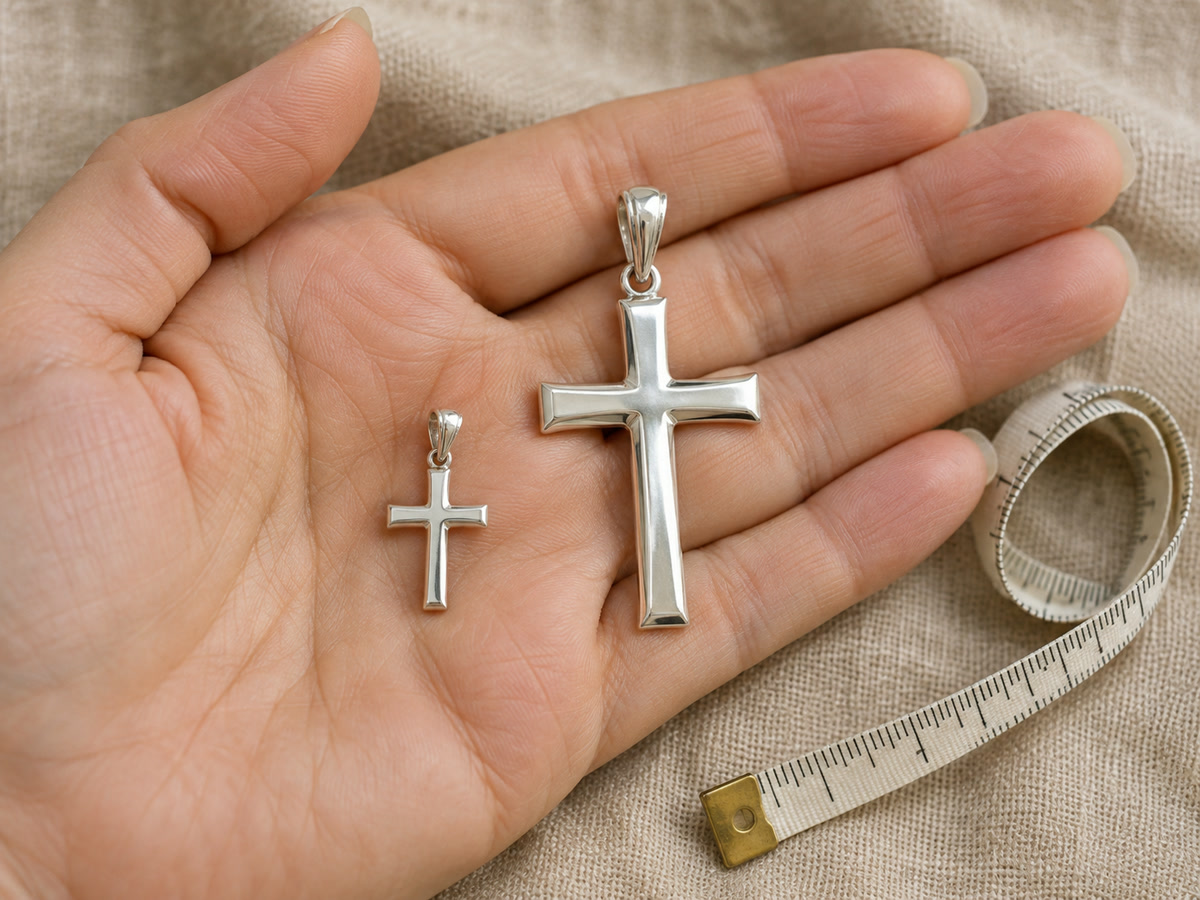
Smaller Sizes, Worn Every Day
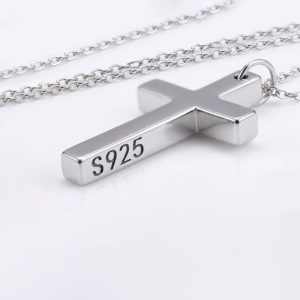
If you are leaning toward bands 1 and 2, these are the pieces that show how much a small cross can carry without a single extra detail.


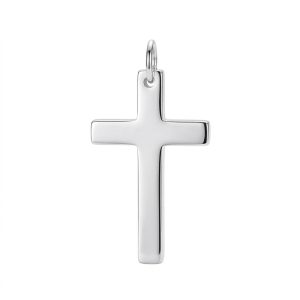
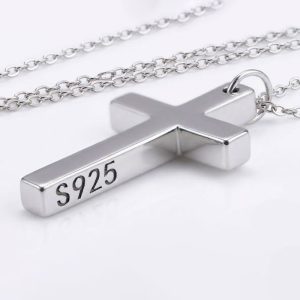
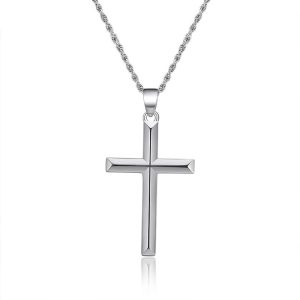
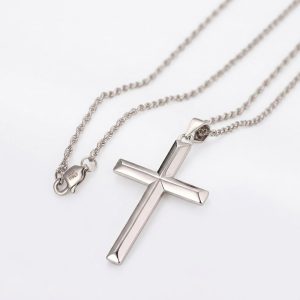
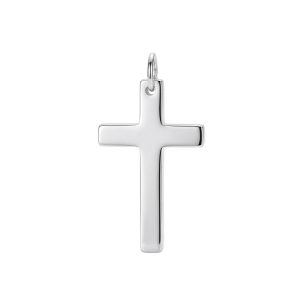
Height, Width, and What Sellers Actually Quote
Here is the part that makes online shopping harder than it should be. Three numbers exist for every cross, and shops rarely say which one they are giving you.
- Height is the measurement from the very top of the loop to the bottom tip. This is the number that matters most, because height is what determines how the piece reads vertically on a neckline.
- Width is the arm span, left edge to right edge. Two crosses with identical heights can differ in width by 30 percent, which changes how bold they feel.
- Thickness is depth, front to back. A 1.5 inch cross that is 3 mm thick looks airy and light. The same outline at 6 mm looks like a medallion.
When a listing gives you a single number with no explanation, assume it is height and check the product photo against a known reference, like a model’s collarbone or the clasp on the chain. When a listing gives you nothing, ask. Any shop that cannot answer a sizing question in writing is telling you something useful about how the piece will arrive.
One more quiet trap: the loop. A tall bail can add two thirds of an inch of visual height that is not part of the cross itself. A 1 inch cross with a generous loop hangs like a 1.4 inch one. Read the total drop, not just the body of the piece.
Match the Size to the Frame, Not the Trend
Body size is not the only variable, but it is the one people get wrong most often, usually by buying too small. A cross is a vertical element sitting on a vertical body. Proportion is everything.
Petite frames
Under 5 foot 3 or narrow shoulders, bands 1 and 2 look complete and intentional. A 1.4 inch solid piece can work here too, provided it is thin and flat. Anything above 1.5 inches tends to overwhelm the collarbone area, which is why petite wearers often report that a large cross “wears them” instead of the other way round.
Broad shoulders and long torsos
Start at band 3 and do not be afraid of band 4. A 0.7 inch cross on a broad frame with a wide neckline shrinks visually and reads as an afterthought. Moving up to 1.2 to 1.5 inches solves the problem instantly, and it usually feels more comfortable too, because the weight sits more evenly.
The two finger test
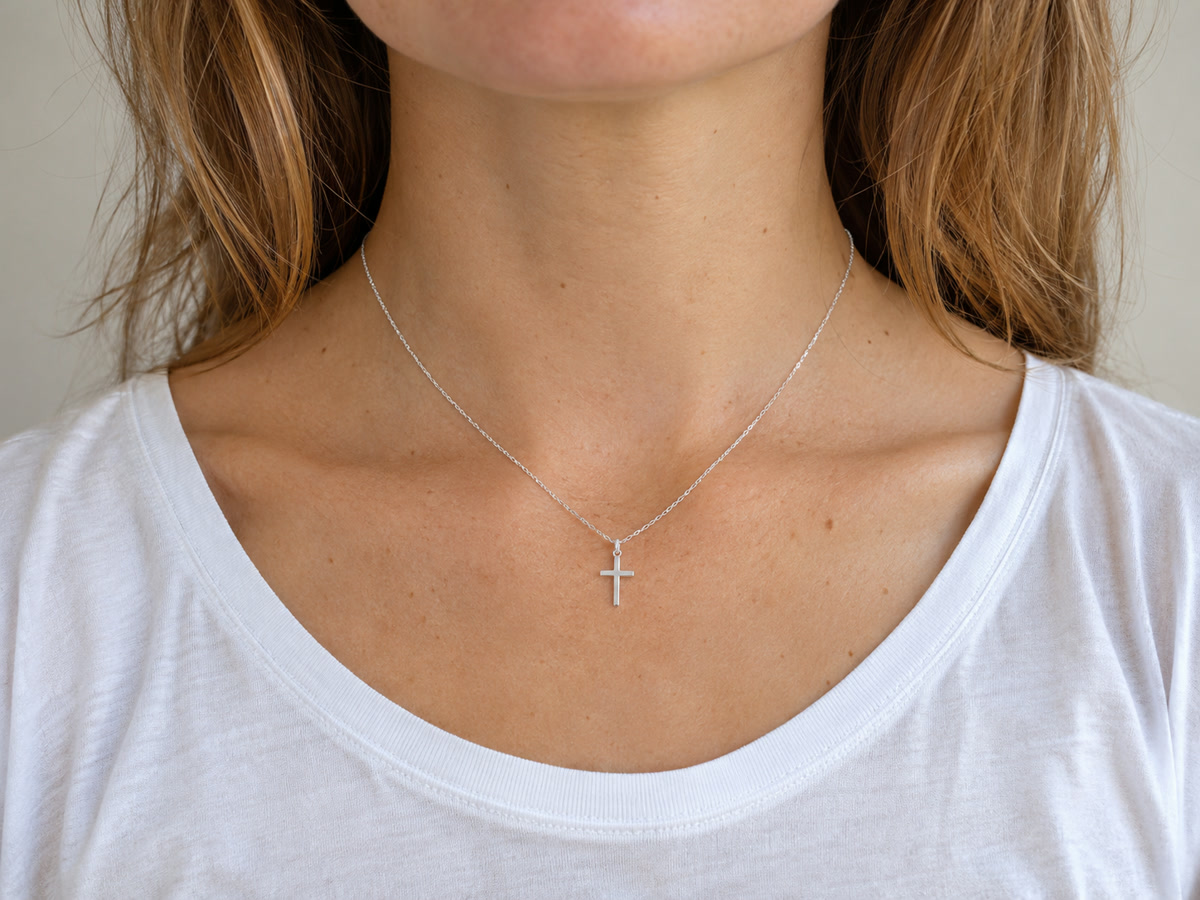
Hold two fingers together horizontally under your collarbone, centred. The arms of the cross should span roughly that distance for a balanced everyday look. Wider than three fingers, and you are in statement territory. Narrower than one finger, and you are wearing a whisper. Crude, but it works in a mirror without a tape anywhere in sight.
Size and Chain Length Are One Decision
You cannot pick a size without picking a chain, because the two multiply each other. The same 0.8 inch cross sits at the hollow of the throat on a 16 inch chain and hangs at the sternum on a 22 inch one. Short chain, the piece becomes the focus. Long chain, it becomes a detail in the landscape of your outfit.
The working combinations that hold up in practice:
- 16 to 18 inch chain with a cross under 1 inch: sits at the base of the throat, looks intentional and neat.
- 20 to 22 inch chain with a cross between 1 and 1.5 inches: the classic adult proportion, sits below the collarbone.
- 24 inch chain or longer with anything over 1.5 inches: keeps the piece from swinging at the waist and gives it room to breathe.
If you are still deciding on the chain itself, our breakdown of how to pick 16, 18 or 20 inches goes through neck measurement, layering, and the lengths that suit particular necklines.
When Going Bigger Is the Right Call
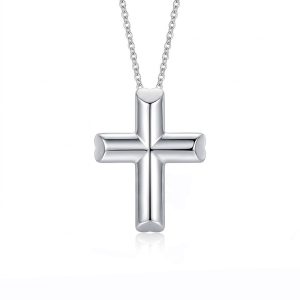
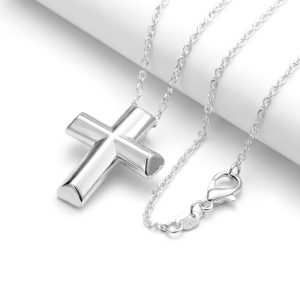
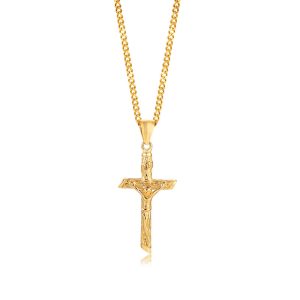
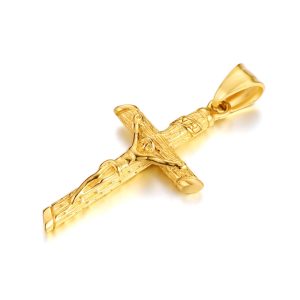
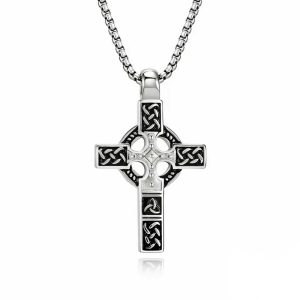
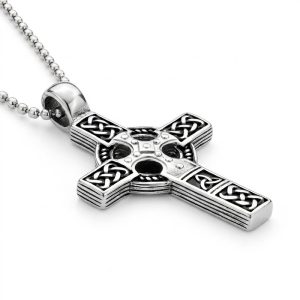
Bigger is not automatically bolder in a bad way. There are clear cases where band 4 and 5 are the correct answer: a piece meant to be worn over a turtleneck or a hoodie, a gift for someone who already owns several delicate crosses, a memorial or milestone piece that should not be subtle, and any wearer with broad shoulders who has been disappointed by small sizes before.
The trade is weight and movement. Larger crosses need thicker chains, cost more in material, and demand a little more care in how they are stored. None of that is a reason to avoid them. It is a reason to buy them on purpose.
Five Sizing Mistakes That Cost Real Money
Buying by photo alone. Product shots are framed to make a cross look substantial. Unless the listing states a measurement or shows the piece on a body, you are guessing. A zoomed image of a 0.5 inch cross fills a screen exactly like a 2 inch one.
Forgetting the recipient’s frame. Gifts go wrong when the buyer shops their own taste. A 1.5 inch statement piece bought for a petite person who wears thin chains will usually sit in a drawer, not out of ingratitude but because it does not feel like theirs.
Ignoring chain compatibility. Putting a heavy cross on a 1 mm cable chain is a structural problem, not an aesthetic one. The chain will stretch, the clasp will strain, and eventually something gives.
Mixing up width and height. A wide, short cross reads bold. A narrow, tall cross reads elegant. Both might be listed as 1.2 inch. If the shape matters to you, the second number matters too.
Sizing up for “value”. More metal is not more quality. A well finished 0.8 inch piece beats an oversized casting with soft edges every time, and it will be worn ten times as often.
How to Measure a Cross You Already Own
If you have a piece you love the fit of, use it as your ruler. Lay it flat, run a ruler from the top of the loop to the bottom tip, and write the number down. Do the same across the arms. Those two figures are your specification, and they will save you from a decade of near misses.
Then measure the chain while you are at it, clasp to clasp, laid straight and untangled. Between the two numbers you have a complete profile of what works on you, which is far more reliable than any size chart written for an average that does not exist.
Related Cross Guides
Once the proportions are settled, the next questions are usually about the shape itself, the metal, and how to keep it looking new. These guides cover each of those in detail.
- 12 Types of Crosses in Christianity: History, Meaning and Guide, the hub that maps every major shape before you commit to one.
- The Latin Cross: History, Symbolism and Meaning
- The Greek Cross: History, Symbolism and Meaning
- The Orthodox Cross: Meaning, History and How to Style It
- Crucifix vs Cross: What Is the Difference, useful if you are still choosing the symbol.
- Gold vs Silver Cross: Which One Should You Pick?
- Sterling Silver vs Stainless Steel: Pros, Cons and Prices
- How to Clean Silver at Home Without Ruining It: 5 Methods, plus our full care guide for storage and daily wear.