Templar Cross Meaning: History, Symbolism and the Knights Behind It
TL;DR – The Templar cross, known as a cross pattée, is the flared emblem the Knights Templar wore on their white mantles in the Middle Ages. It stands for faith, courage and protection, and it is one of the rare medieval symbols that made it all the way into modern style. Here is where it came from, what it actually meant, and how people wear it today.
The cross with the widening arms pops up everywhere once you notice it: on pendants, on tattoos, on movie posters, on old cathedral walls. Most people can draw it from memory and almost nobody knows its actual name. It is called a cross pattée, it is tied to one of the most legendary military orders in history, and its story is better than the legend suggests. If shapes like this one are your thing, our cross collection is the right place to browse after reading.
What the Templar Cross Actually Is
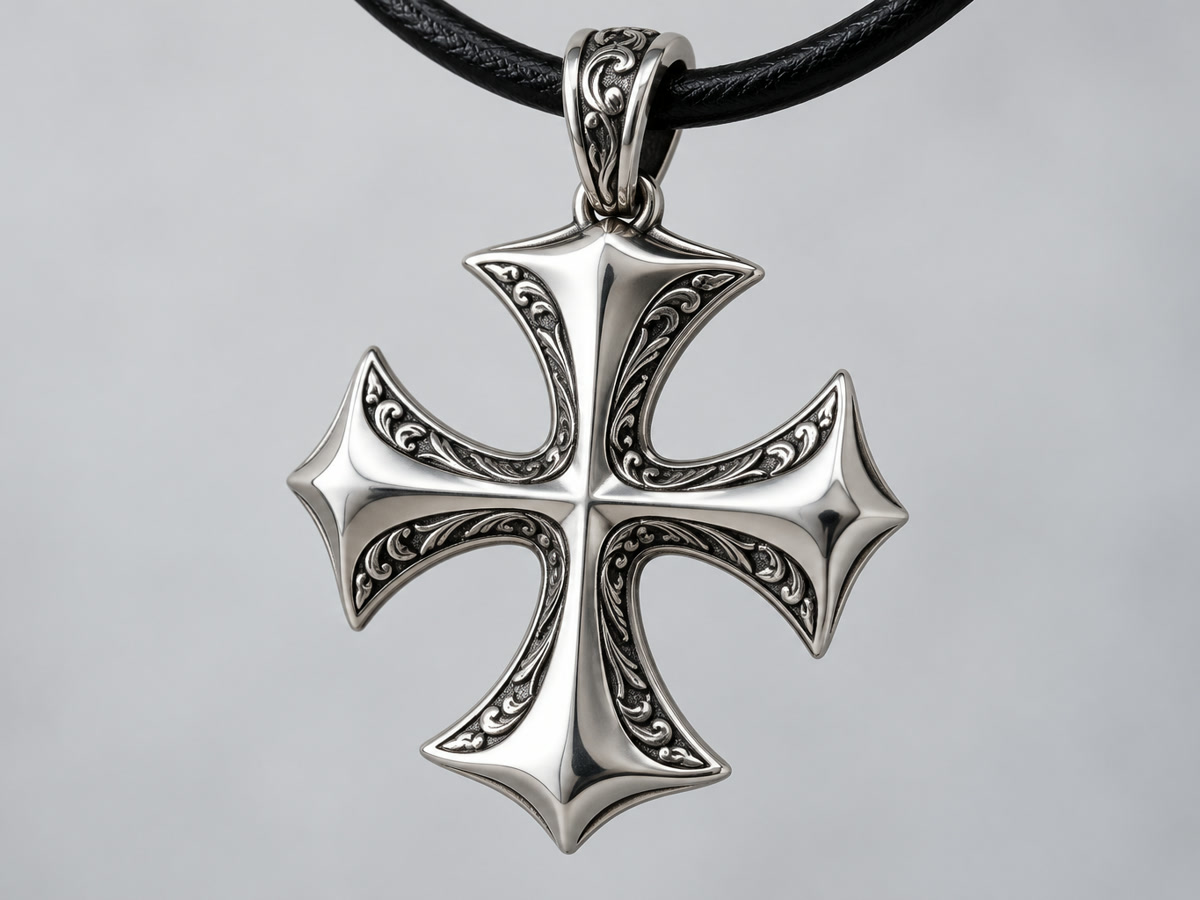
Start with the shape, because the name trips people up. A cross pattée is a cross whose four arms are narrow at the center and widen as they move outward, ending in broad flat edges. The word comes from the French pattée, meaning shaped like a paw. No claws involved, just geometry. It is instantly different from a Latin cross, which uses beams of even width, and from a Maltese cross, whose arms are cut into a V at the tips.
That flared shape was not invented for the Templars. Cross pattée forms show up in early Christian art, on Byzantine coins and on church carvings centuries before any knight took a vow. What the Knights Templar did was make it famous. By the twelfth century the flared red cross on a white mantle was the most recognizable uniform in Europe, and the shape has carried that association ever since.
The Knights Templar: A Very Short History
The Poor Fellow-Soldiers of Christ and of the Temple of Solomon, to use their full name, were founded around 1119 by a handful of French knights led by Hugues de Payens. Their original job was unglamorous: guarding Christian pilgrims on the road from Jaffa to Jerusalem. Nine men, a headquarters on the Temple Mount, and a mission statement. That is how it started.
Two things turned them into an institution. First, Bernard of Clairvaux, one of the most influential churchmen of the twelfth century, wrote the rule of the order and championed it publicly. In 1129 the Council of Troyes gave the young order official recognition, and recruits and money started flowing in. Second, the Templars invented an early version of international banking. A pilgrim could deposit funds in Paris and withdraw them in Jerusalem using a coded letter of credit, which beat walking across the Mediterranean with a pouch of gold sewn into his tunic.
The Red Cross on the Mantle
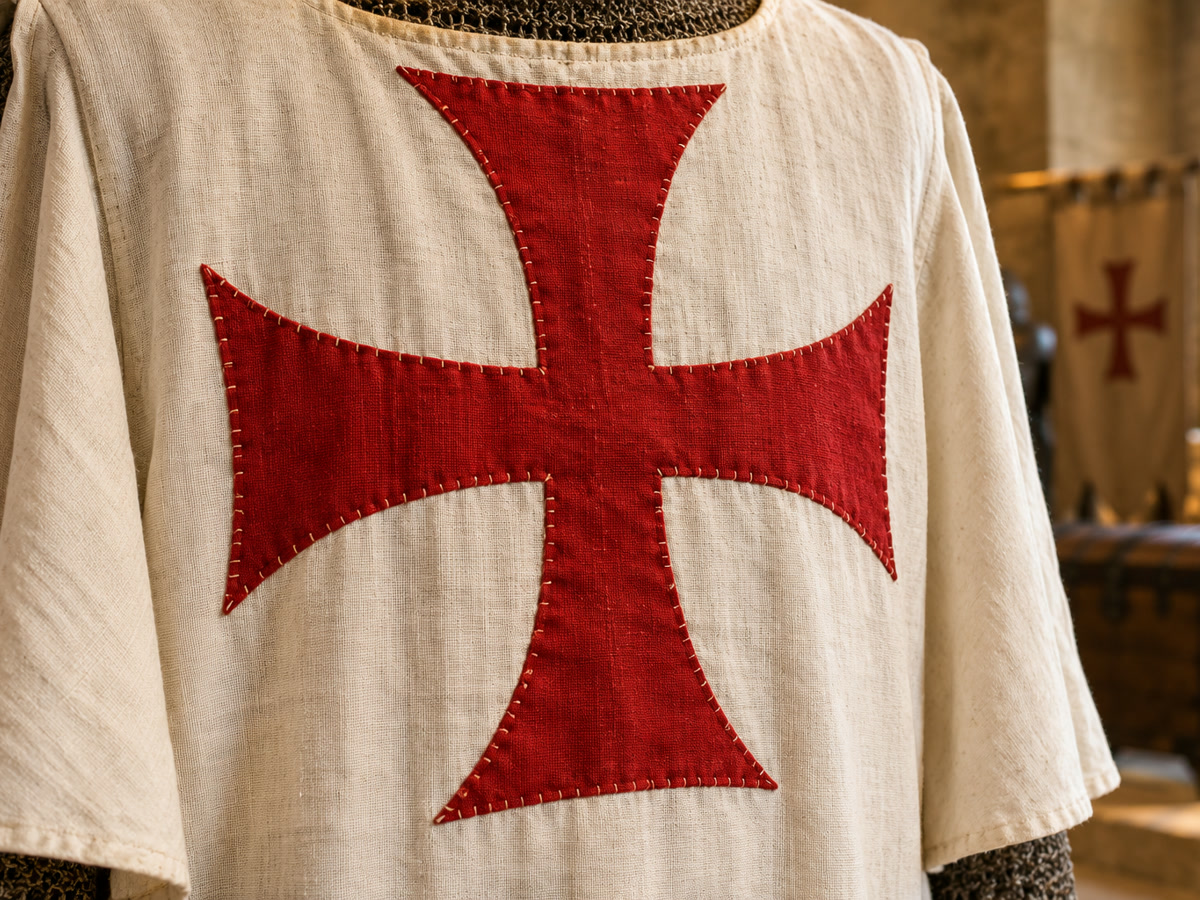
The white mantle was the order’s everyday habit, and in 1147 Pope Eugene III granted them the right to wear a red cross upon it. That red cross, most often shown with flared arms, is the emblem this article is about. It was worn on the left shoulder, over the heart, and it served a practical purpose as well as a spiritual one: on a battlefield dusted with crusader and Saracen banners alike, the red cross told friend from foe at a distance. Heraldry with a job to do.
For nearly two centuries the order grew into something between an army, a bank and a religious community. It was dissolved in 1312 under pressure from King Philip IV of France, who had arrested the Templars in 1307 and wanted their wealth. The last grand master, Jacques de Molay, was burned at the stake in 1314. The organization disappeared. The symbol did not.
What the Templar Cross Means
The short version: faith, courage, protection. The longer version is more interesting, because the symbol carries three layers at once.
The Three Layers of Meaning
Layer One: Christian Faith and the Crusades
At face value the Templar cross is a Christian emblem. It marked men who had taken vows of poverty, chastity and obedience, who attended mass daily and who fought under a banner that named their cause. Worn today, it most often signals an attraction to that era of Christian history, or a personal devotion the wearer prefers to keep compact and symbolic rather than spelled out.
Layer Two: Courage Under Pressure
The Templars were famous for holding ground they were not supposed to hold. Whatever one thinks of the Crusades as a whole, the order’s personal reputation was built on men who did not break. That is the layer most people tap into when they wear the symbol: not a religious claim, but a private reminder to stay steady. The flared arms help here too, they read as motion, like something pushing outward.
Layer Three: Protection and the Guardian Idea
The original job of the order was protection of travelers, and that guardian reading has stuck. A Templar cross is frequently chosen as a talisman, a piece that watches over the wearer. It is the same instinct that makes people wear a saint’s medal or keep a small symbol in a pocket during something hard. The story supports it: these were, quite literally, the people whose task was to keep others safe.
Worth adding for the accuracy minded: the flared cross is associated with several military and religious orders beyond the Templars. The Teutonic Knights used a white cross pattée, and the shape shows up in later European orders and decorations. The Templar claim is the most famous, not the only one.
How to Tell a Templar Cross From Lookalikes
Three shapes get confused constantly. A quick field guide, so you know exactly what you are looking at on a product page, a tattoo flash sheet or a museum label.
Cross Pattée vs Maltese Cross
The Maltese cross has eight points, four V shaped arms with notched ends, and it belongs to the Knights of Malta, a different order with its own story. The Templar cross has four flat widening arms and no notches. If the tips look like they were cut with scissors at an angle, you are looking at a Maltese cross.
Cross Pattée vs Iron Cross
The Iron Cross is a nineteenth century German military decoration whose arms also widen, but its edges are straight and symmetrical with a distinct border, and it carries a very different history. Visually the giveaway is the frame: the Iron Cross almost always has a raised rim around the whole shape. The Templar cross is usually flat and plain, often just one solid color.
Cross Pattée vs Cross Fleury and Cross Pattée Moliné
A cross fleury ends in flower petals, a cross pattée moliné curves the tips inward like a swallowtail. Both are heraldic cousins, both are rarer in everyday jewelry. The plain cross pattée, with simple widening arms and a flat end edge, is the version people mean when they say Templar cross.
How to Wear a Templar Cross Today
The shape is bold, so it does the heavy lifting in an outfit. A few rules that hold up across styles.
On a Leather Cord
The most natural pairing. A cross pattée in sterling silver or blackened steel on a plain leather or waxed cord reads rugged and understated, close to the original spirit of the thing. Works over a t shirt, works with a flannel, works with a hoodie. This is the everyday version.
On a Chain
Put the same cross on a box or curb chain and the piece turns sharper, more urban. Silver on silver stays quiet, black on black stays quiet, gold is where it starts asking for attention. If you are layering, keep the other pieces plain: the pattée shape already has enough personality for one chest.
As a Pocket Piece or Keychain
Not everything has to be worn. A small cross pattée in a pocket or on a bag strap works as the modern version of the talisman reading from the meaning section, something to find with your hand when a day goes sideways.
One practical note on materials. Silver will tarnish eventually and needs an occasional wipe, stainless steel barely needs anything, and gold plating is the one to treat kindly if you want it to last. Our guide on cleaning silver at home without ruining it covers the low effort methods that actually work.

Why the Symbol Never Left
Plenty of medieval emblems are confined to museum plaques. The Templar cross made it into everyday life, and there is a fairly simple reason for that: the order it belonged to vanished in a single dramatic sweep. No institution survived to gatekeep the symbol. No nation adopted it as a flag. It stayed unclaimed, and unclaimed symbols drift freely.
Freemasonry picked it up in its Templar themed degrees, romantic literature of the nineteenth century turned the knights into characters, and from there the shape passed into film, games and tattoo culture. Each of those handoffs stripped away a bit of the specific history and left the visual idea intact: an old, serious, flared cross that carries weight without saying much.
The result is a symbol that works in two registers at once. To someone who knows the history it reads as a specific reference to a twelfth century order of warrior monks. To everyone else it reads as a strong cross shape with old roots. Both readings are fine, and that flexibility is exactly why the design is still being made, worn and drawn eight centuries after the order that made it famous was dissolved.
Bottom Line
The Templar cross is a cross pattée, a shape older than the order itself, made iconic by nine knights guarding a road to Jerusalem in 1119. It means faith, courage and protection, depending on which layer you care about, and it happens to be a genuinely good looking piece of geometry. Whether you wear it for the history, for the reminder, or simply because flared arms beat plain beams, you are wearing one of the few medieval symbols that never needed a revival.
Related Cross Guides
If the Templar cross is your kind of shape, the rest of our cross guides go deeper on the symbols around it, from the crusader era Jerusalem cross to the everyday question of which metal to pick.
- 12 Types of Crosses in Christianity: History, Meaning and Jewelry Guide, the hub that maps every major shape in one place.
- Jerusalem Cross: Meaning, History and Symbolism, the five crossed companion piece from the same crusader world.
- Celtic Cross Meaning: What the Ring Really Stands For, another old cross whose symbol outlived its makers.
- Orthodox Cross: Meaning, History and How to Style It, the three barred cross of the Eastern tradition.
- Crucifix vs Cross: What’s the Difference and Which One Should You Wear?, useful before choosing any cross piece with a figure on it.
- Tau Cross: Meaning and History (coming soon), the simple T shaped cross of Saint Anthony.
- Saint Andrew’s Cross: Meaning and Symbolism (coming soon), the X shaped saltire and its Scottish story.