
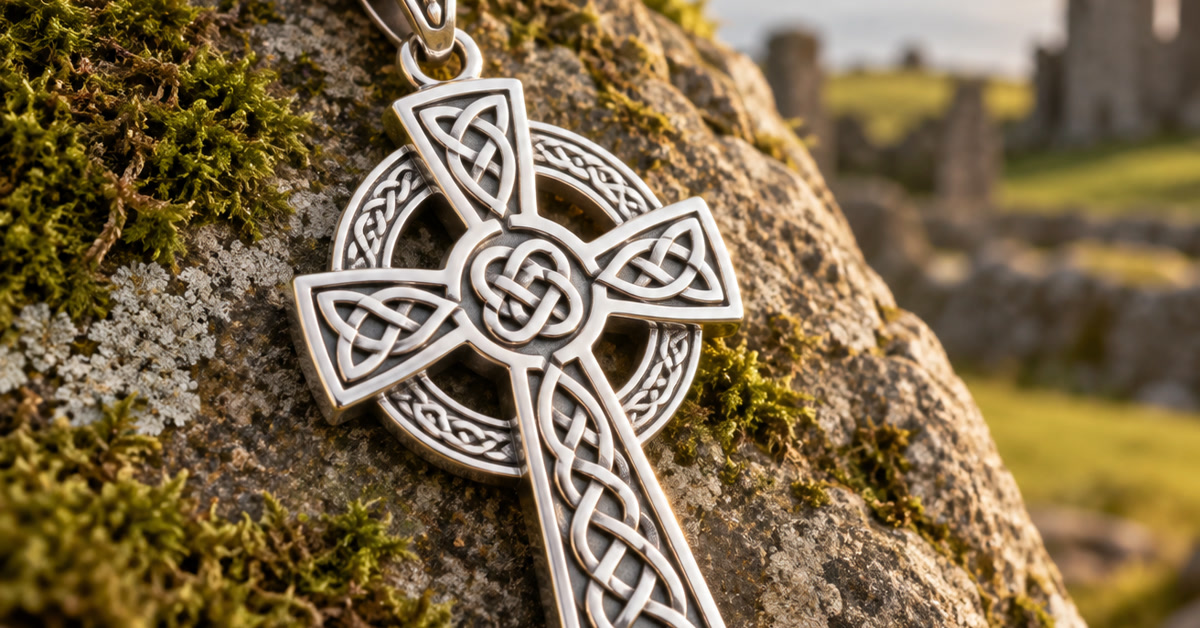
Celtic Cross Meaning: What the Ring Really Stands For
TL;DR – The ring on a Celtic cross represents eternity, divine glory, or the halo of Christ. It first appeared on stone high crosses in Ireland and Scotland around the 9th century. Today, Celtic cross necklaces carry that same symbolism: faith without end, heritage, and the unbroken bond between the earthly and the divine. Whether you choose sterling silver or gold-plated stainless steel, a Celtic cross pendant says something a plain cross cannot.
You’ve seen the shape everywhere: a Latin cross with a circle sitting at the intersection of its arms. It shows up on gravestones in Irish cemeteries, on pub signs in Dublin, on pendant necklaces in jewelry shops from New York to Galway. But what does that ring actually mean? Is it decorative? Religious? Pagan? The answer is more interesting than any of those single labels, and it goes back over a thousand years to the green hillsides of early medieval Ireland. If you want to carry that history yourself, our Celtic cross necklace collection gathers the designs that get the ring and the knotwork right.
Where the Celtic Cross Came From
The Celtic cross emerged in Ireland and Britain during the Early Middle Ages, roughly between the 7th and 9th centuries. It belongs to a family of symbols known as “ringed crosses,” and it became the defining visual marker of Insular Christianity, the distinctive form the faith took in the British Isles before the Norman period.
The earliest examples appear as massive stone high crosses, erected in churchyards and monastic sites across Ireland and Scotland. Two clusters of the oldest surviving crosses stand out: the group at Ahenny in County Tipperary, Ireland, and the crosses on Iona, a small island off the Scottish coast that was home to one of the most influential monasteries in early medieval Europe. These crosses date to roughly the 9th century and already display the full form we recognize today: a Latin cross with a ring encircling the junction of the arms.
Why did Irish and Scottish Christians add a ring to the cross? Historians have proposed several explanations, and none of them cancel each other out.
The Structural Theory
The simplest explanation is practical. Stone is heavy. A Latin cross with long horizontal arms puts enormous stress on the point where the arms meet the vertical shaft. A ring connecting the arms acts as a structural brace, distributing the weight and preventing the arms from snapping off. For carvers working in sandstone and granite, this was not a minor advantage.
The Theological Theory
The ring also carried deep symbolic weight. In Christian iconography, a circle represents eternity, God’s unending nature, and the infinite reach of divine promise. The Church Fathers wrote about the “cosmological cross,” a cross framed by a celestial sphere representing the cosmos redeemed through Christ. This concept appears in the Carmen Paschale, a Latin poem by Coelius Sedulius that was widely read in Ireland by the 7th century. The ring, in this reading, is not decoration. It is a theological statement: the cross of Christ encompasses all of creation, and his sacrifice has no end.
The Cultural Adaptation Theory
A popular tradition holds that Saint Patrick, when converting the Irish, combined the Christian cross with the sun wheel, a symbol already present in pre-Christian Celtic art. By merging the two, he made the new faith feel familiar rather than foreign. While modern historians debate whether Patrick personally introduced the ringed cross, the broader point holds: the ring helped the cross resonate in a culture that already understood circles as symbols of cycles, seasons, and the sun. It was a bridge between worlds.
What the Ring Symbolizes
Across centuries and denominations, the ring on the Celtic cross has gathered several layers of meaning. Here are the interpretations that have endured.
Eternity and God’s Unending Nature
The circle has no beginning and no end. In Christian theology, this maps directly onto the nature of God: “I am the Alpha and the Omega, the first and the last, the beginning and the end” (Revelation 22:13). When you wear a Celtic cross, the ring declares that the faith it represents is not temporary, not conditional, not subject to time. It is eternal.
The Halo of Christ
In medieval art, a circle behind a figure’s head indicated divine glory, the radiant light of holiness. Applied to the cross, the ring functions as a nimbus, a halo surrounding the intersection where heaven meets earth. The cross is where Christ’s sacrifice happened. The ring says that this moment was not merely historical. It was, and remains, divine.
The Unity of Faith and the World
Some scholars read the ring as a symbol of the world, with the cross rising through it. In this interpretation, the Celtic cross declares that Christian faith is not separate from daily life but woven through it. The vertical arm reaches toward God. The horizontal arm spans human relationships. The ring holds them together.
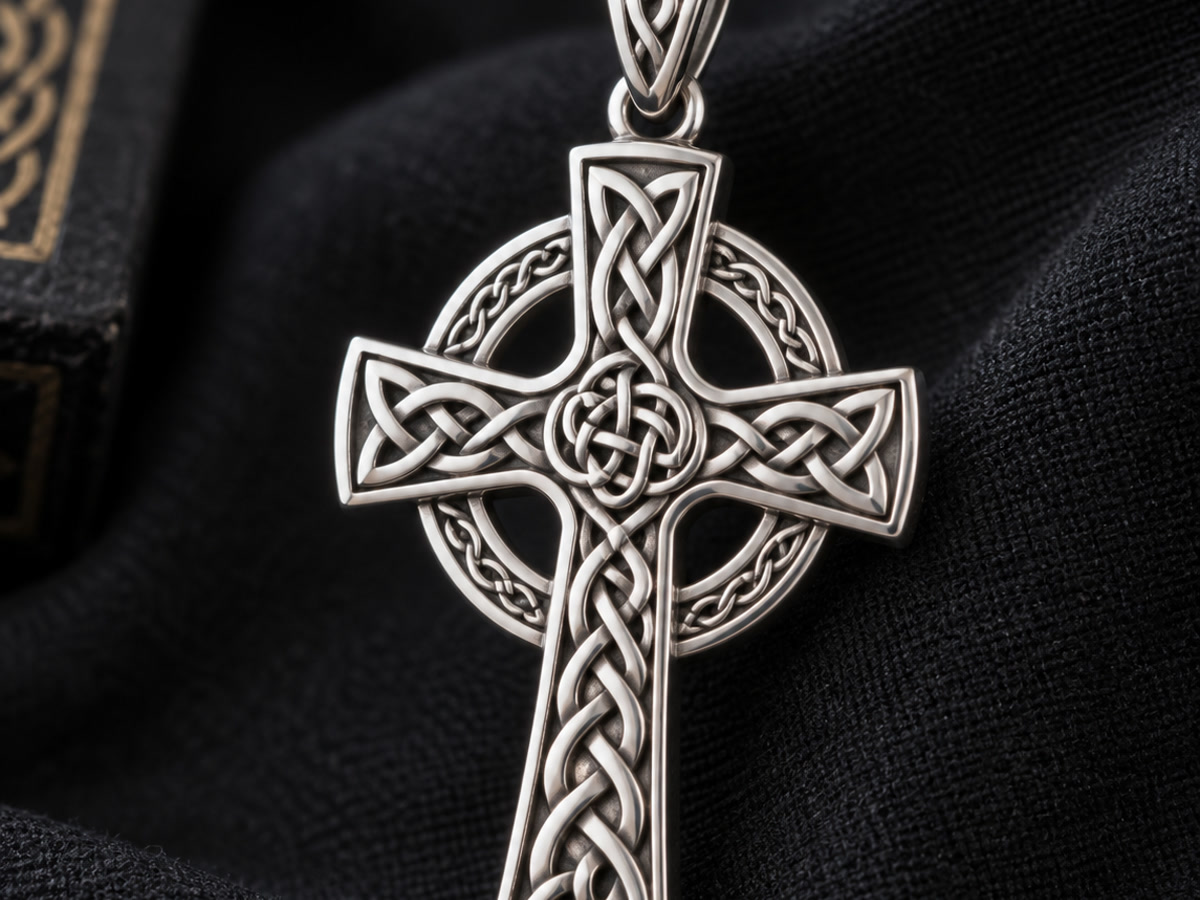
Celtic Cross vs Latin Cross: What Changes With the Ring?
A Latin cross is the most familiar Christian symbol in the world: a vertical bar intersected by a shorter horizontal bar, with no additional elements. It is simple, universal, and recognized across virtually every Christian tradition.
The Celtic cross takes that same Latin cross and adds the ring. This single addition changes the character of the symbol significantly:
- Cultural identity. The Latin cross says “Christian.” The Celtic cross says “Christian, and specifically connected to the traditions of Ireland, Scotland, Wales, or Cornwall.”
- Visual richness. The ring creates a natural frame for ornamentation. Celtic cross pendants often feature intricate knotwork, spirals, and interlace patterns within and around the ring, making them among the most visually detailed cross designs available.
- Additional symbolism. The ring adds the eternity motif, the halo motif, and the world-encirclement motif on top of everything the Latin cross already carries. It is the same foundation with extra layers of meaning.
Both are legitimate Christian symbols. Neither is “better” or “more correct.” The choice comes down to what resonates with you: the clean simplicity of the Latin cross, or the layered symbolism and cultural heritage of the Celtic form.
The High Crosses: Ireland’s Stone Legacy
Between the 9th and 12th centuries, Irish and Scottish monasteries erected hundreds of stone high crosses across the landscape. These were not small grave markers. Many stood over three meters tall, carved from single blocks of sandstone or granite, and covered in intricate biblical scenes, knotwork patterns, and decorative panels.
The most famous include the Cross of the Scriptures at Clonmacnoise, the Muiredach High Cross at Monasterboice (often called the “finest high cross in Ireland”), and St. John’s Cross on Iona. Each one displays the ringed form, and each one served multiple purposes: marking sacred ground, teaching biblical stories to a largely illiterate population, and asserting the presence and authority of the monastery that built it.
These stone crosses are the direct ancestors of the Celtic cross pendant you can wear around your neck today. The shape has not changed. The meaning has not changed. Only the scale has.

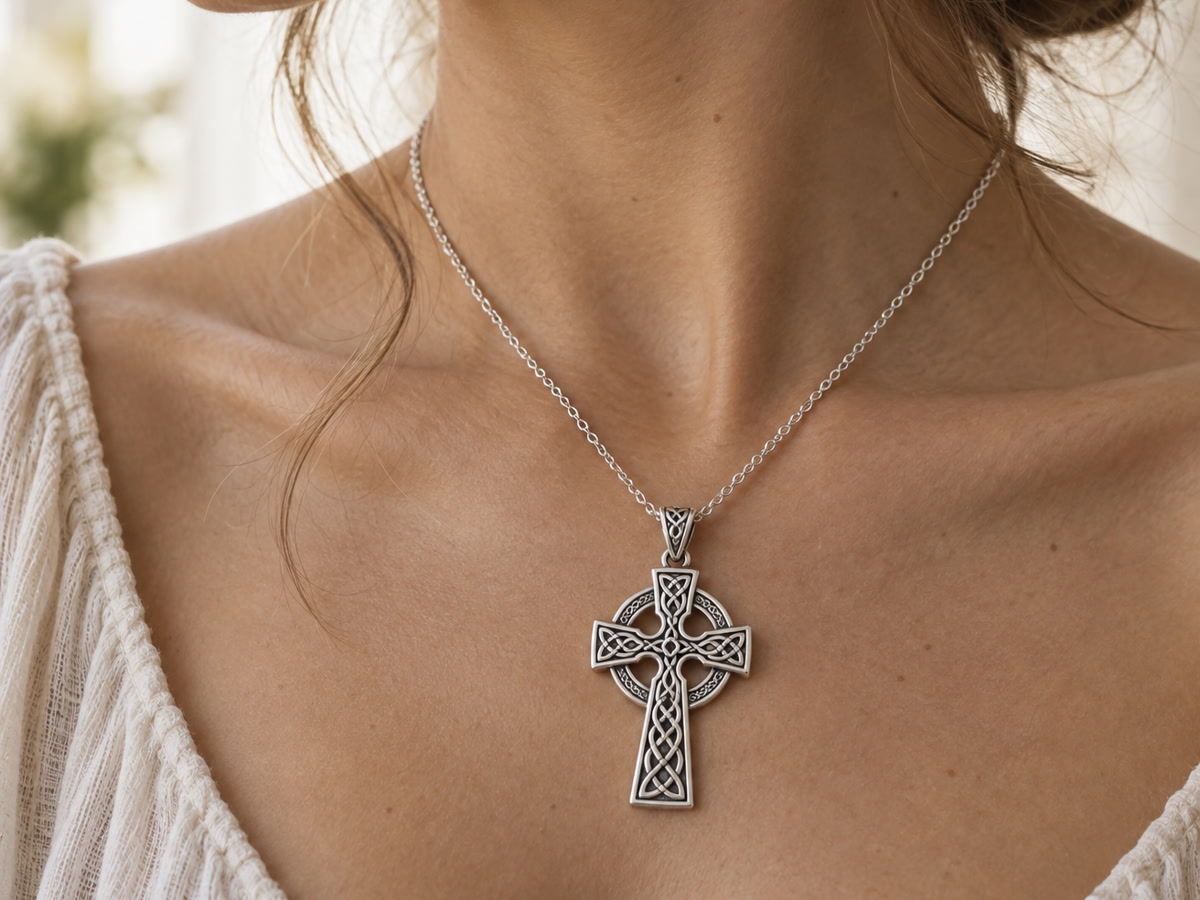
Celtic Cross Meaning in Modern Jewelry
Wearing a Celtic cross necklace today carries all of that historical weight, filtered through personal intent. Here is what people typically mean when they choose this design.
Faith and Devotion
For many wearers, a Celtic cross is simply a way to carry their Christian faith in a form that feels distinctive. It is unmistakably a cross, unmistakably Christian, and the ring and knotwork give it a richness that a plain cross does not have. People wear them to church, to work, every day. The ring reminds them that their faith is not a part-time commitment.
Irish and Celtic Heritage
The Celtic cross is one of the most recognized symbols of Irish identity worldwide. For people with Irish, Scottish, Welsh, or Cornish ancestry, wearing a Celtic cross connects them to a specific place and history. It says: my roots matter to me. This is especially true for the diaspora, for people whose families left Ireland generations ago but kept the symbol alive.
Knotwork as a Statement
Celtic knotwork, the interlacing patterns that typically decorate the arms and ring of the cross, carries its own symbolism. A continuous line with no beginning and no end represents eternity. A knot that weaves over and under represents the interconnectedness of life and spirit. When these patterns appear on a cross pendant, they reinforce the ring’s message: what this symbol stands for does not end.
A Gift With Story
Celtic cross necklaces make meaningful gifts precisely because they carry so much narrative. A mother giving a Celtic cross to her child at Confirmation is not just handing over a piece of jewelry. She is passing on a symbol that connects faith, family history, and cultural identity in a single pendant. For baptisms, weddings, graduations, or simply as a “thinking of you” gesture, the Celtic cross carries a weight that a generic pendant cannot match.
Our Celtic cross collection, designed with authentic knotwork and lasting materials. :
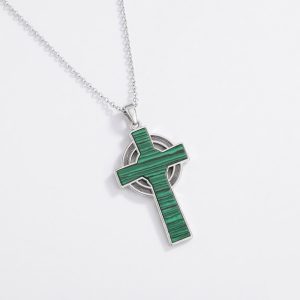
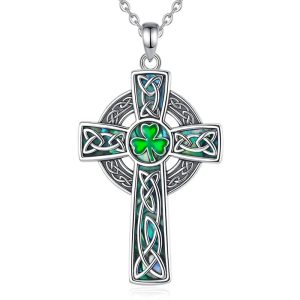
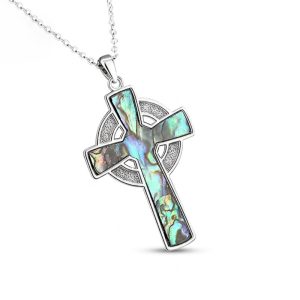


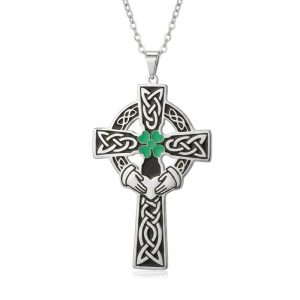

How to Choose a Celtic Cross Pendant
Not all Celtic cross pendants are created equal. The design details matter, both for meaning and for how the piece looks and wears over time.
Material
925 sterling silver is the classic choice for Celtic cross jewelry. It takes detail well, develops a natural patina that many wearers love, and pairs beautifully with the organic curves of knotwork. It does require occasional polishing to maintain its shine, but that maintenance is part of the relationship with the piece.
Stainless steel offers extreme durability and a more contemporary look. It will not tarnish, scratch easily, or react with skin. For people who want a Celtic cross they can wear in the shower, at the gym, and to work without thinking about it, stainless steel is the practical choice.
Gold-plated stainless steel combines the warmth and prestige of gold with the resilience of steel. PVD-coated options hold their color far longer than traditional gold plating, making them a solid middle ground between appearance and longevity.
Knotwork Detail
The quality of the knotwork defines the piece. Look for clean, defined interlace patterns where you can clearly trace the line as it weaves over and under. Cheap Celtic cross pendants often have blurred or simplified knotwork that loses the very detail that makes the design meaningful. Higher-quality pieces maintain sharp, visible crossings even at small pendant sizes.
Chain Length and Pendant Size
A Celtic cross pendant works best when the knotwork is visible, so size matters. Pendants under 20mm can lose the detail of the interlace. Pendants in the 25mm to 40mm range hit the sweet spot: large enough to read the patterns, small enough for everyday wear. Pair with a chain length that lets the pendant sit at mid-chest, typically 20 to 24 inches for men and 18 to 20 inches for women.
Celtic Cross Care Tips
A Celtic cross pendant with detailed knotwork deserves proper care to keep those interlace patterns looking sharp.
Sterling silver: Store in a dry, sealed bag when not wearing to slow tarnishing. Clean gently with a soft cloth. For deeper cleaning, use a baking soda paste (baking soda mixed with a few drops of water), apply with a soft brush to get into the knotwork crevices, rinse, and dry thoroughly.
Stainless steel: Wipe with a damp cloth after wearing. For stubborn spots, a mild soap and water solution works well. Avoid abrasive cleaners that could scratch the surface.
General rule: Remove your Celtic cross necklace before swimming, showering (for silver), or using harsh cleaning products. The chemicals in chlorine, salt water, and household cleaners can damage finishes and accelerate tarnishing.
Related Cross Guides
Want to learn more about cross symbolism, styles, and care? These guides cover everything from history to choosing the right piece.
- 12 Types of Crosses in Christianity: History, Meaning & Jewelry Guide (the full hub)
- The Latin Cross: History, Symbolism & Meaning
- The Greek Cross: History, Symbolism & Meaning
- Orthodox Cross: History, Symbolism & How to Style It
- Crucifix vs Cross: What’s the Difference?
- Gold vs Silver Cross Necklace: Which One Should You Pick?
- Sterling Silver vs Stainless Steel Cross Jewelry: Pros, Cons & Prices
- How to Clean Silver Jewelry at Home Without Ruining It
- Crystia Jewelry Care Guide