-

Why So Many Cross Designs?

The cross is the universal symbol of Christianity, but it has never been a one-shape-fits-all design. As the faith spread across different cultures, regions, and centuries, local artisans adapted the basic cross form to reflect their own artistic traditions, theological emphases, and sometimes political alliances. A Byzantine cross looks nothing like an Irish cross, and neither resembles the crosses used by Crusader knights. These variations were not just decorative choices. They carried real meaning for the people who wore them, carved them into stone, or painted them on manuscripts.

Understanding these variations matters for anyone shopping for cross jewelry. A budded cross says something different from a Latin cross. A mariner’s cross tells a story that a plain pendant cannot. Knowing the difference helps you pick a piece that actually resonates with you, rather than settling for whatever happens to be on the shelf.

The Budded Cross (Cross Bottony)

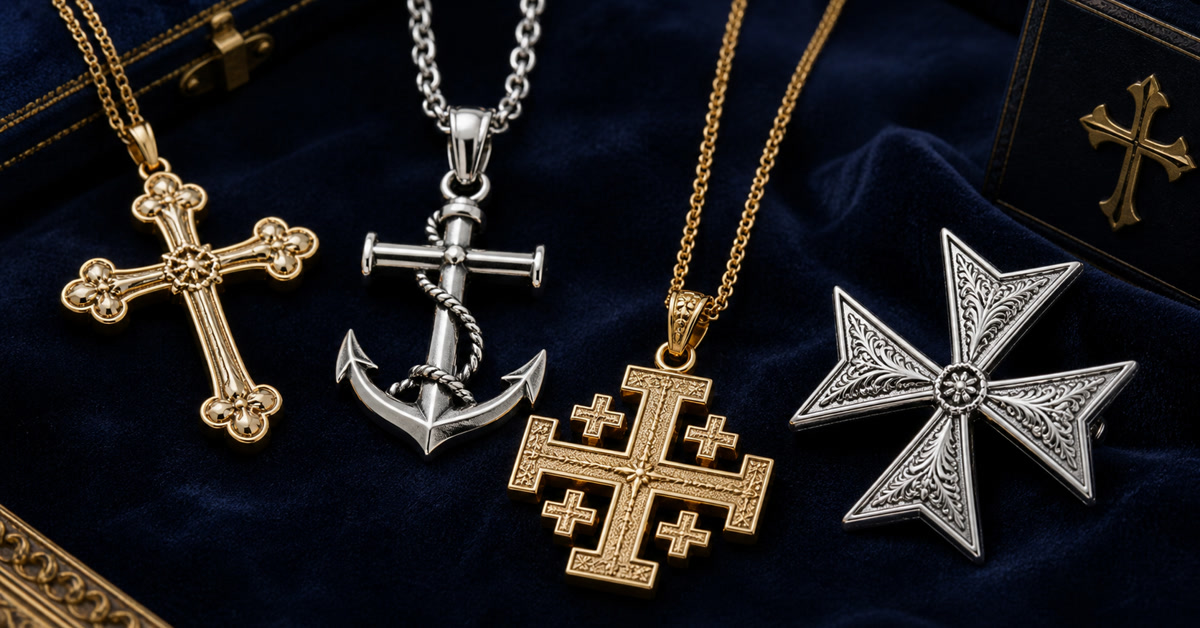
The budded cross, also called the cross bottony or trefoil cross, features a small three-lobed ornament at the end of each arm. Those lobes are not just decoration. In Christian symbolism, the three buds on each arm represent the Holy Trinity: the Father, the Son, and the Holy Spirit. Some historians also connect the trefoil shape to the Celtic shamrock, which Saint Patrick reportedly used to explain the Trinity to Irish converts in the fifth century.

The budded cross appears prominently in heraldry and ecclesiastical architecture across England, Wales, and Ireland. You will find it carved into medieval church walls, embroidered on vestments, and stamped onto religious medals. In England, the budded cross is sometimes associated with the Church of England and appears on clergy badges and diocesan crests.

As jewelry, the budded cross offers a distinctive silhouette. The trefoil endings give it more visual weight and texture than a plain Latin cross, while still maintaining a clean, recognizable shape. It works well in both sterling silver and gold, and the lobed details catch light in a way that flat crosses do not. For anyone looking for a cross pendant that stands out without being overly ornate, the budded cross is an excellent choice.
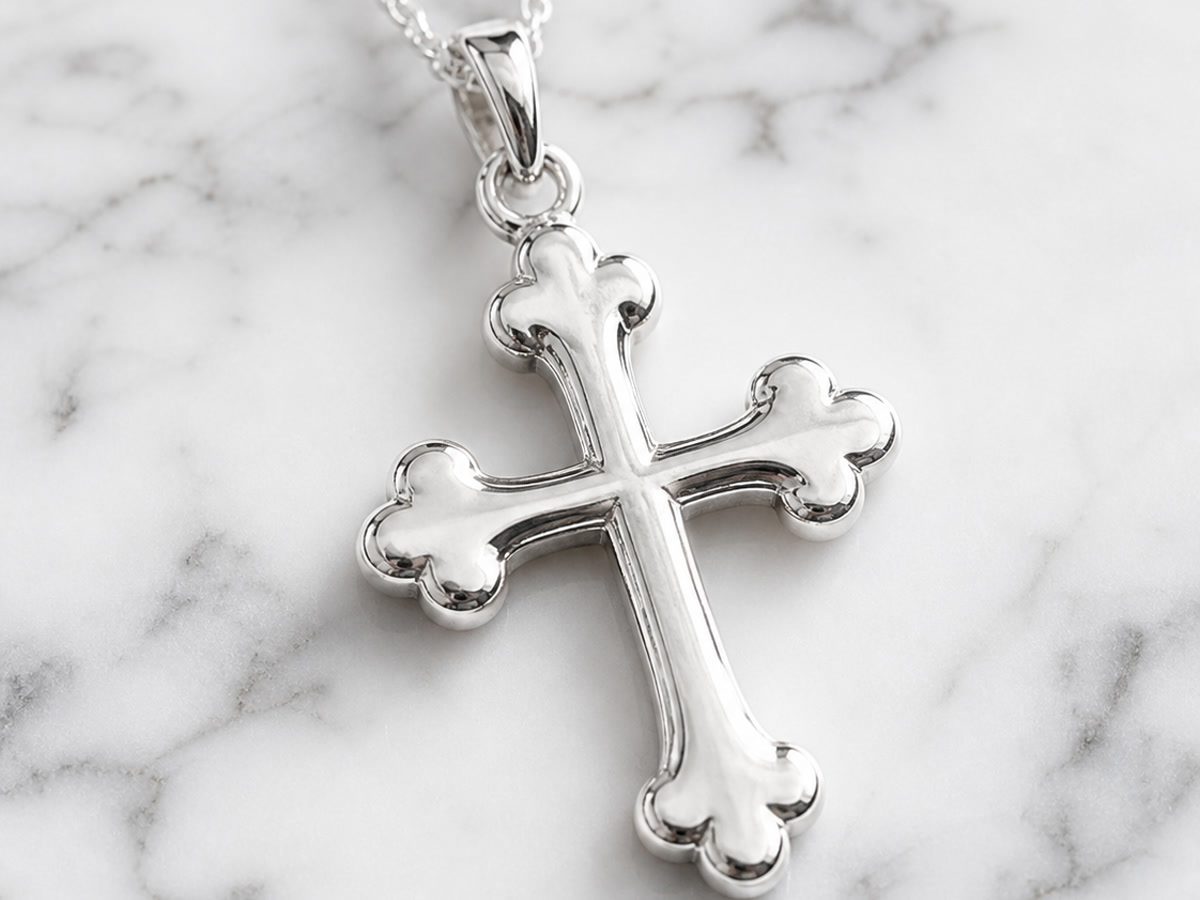
Sterling silver budded cross pendant with trefoil endings on each arm, hanging from a delicate chain on a white marble surface

The Mariner’s Cross (Anchor Cross)

The mariner’s cross merges two of the oldest Christian symbols: the cross and the anchor. In the earliest centuries of the faith, before the cross became the dominant symbol, Christians used the anchor as a secret sign of hope. The anchor represented stability and steadfastness, drawn from the Epistle to the Hebrews, which describes hope as “an anchor of the soul.” By combining the anchor with the cross form, early Christians created a design that simultaneously expressed faith and resilience.

You will encounter the mariner’s cross most often in coastal and maritime communities. Fishing villages in Portugal, Greece, and the Caribbean feature the anchor cross on churches, grave markers, and harbor walls. It was particularly popular among sailors and seafarers who prayed for safe passage and saw the cross-anchor as a symbol of divine protection on the water.

In jewelry, the mariner’s cross has a rugged, distinctive look. The curved arms and horizontal bar create a silhouette that is immediately recognizable and quite different from standard cross pendants. It appeals to people who want their cross jewelry to carry an additional layer of meaning beyond the basic symbol, and it works particularly well in stainless steel or oxidized silver finishes that evoke a nautical aesthetic.
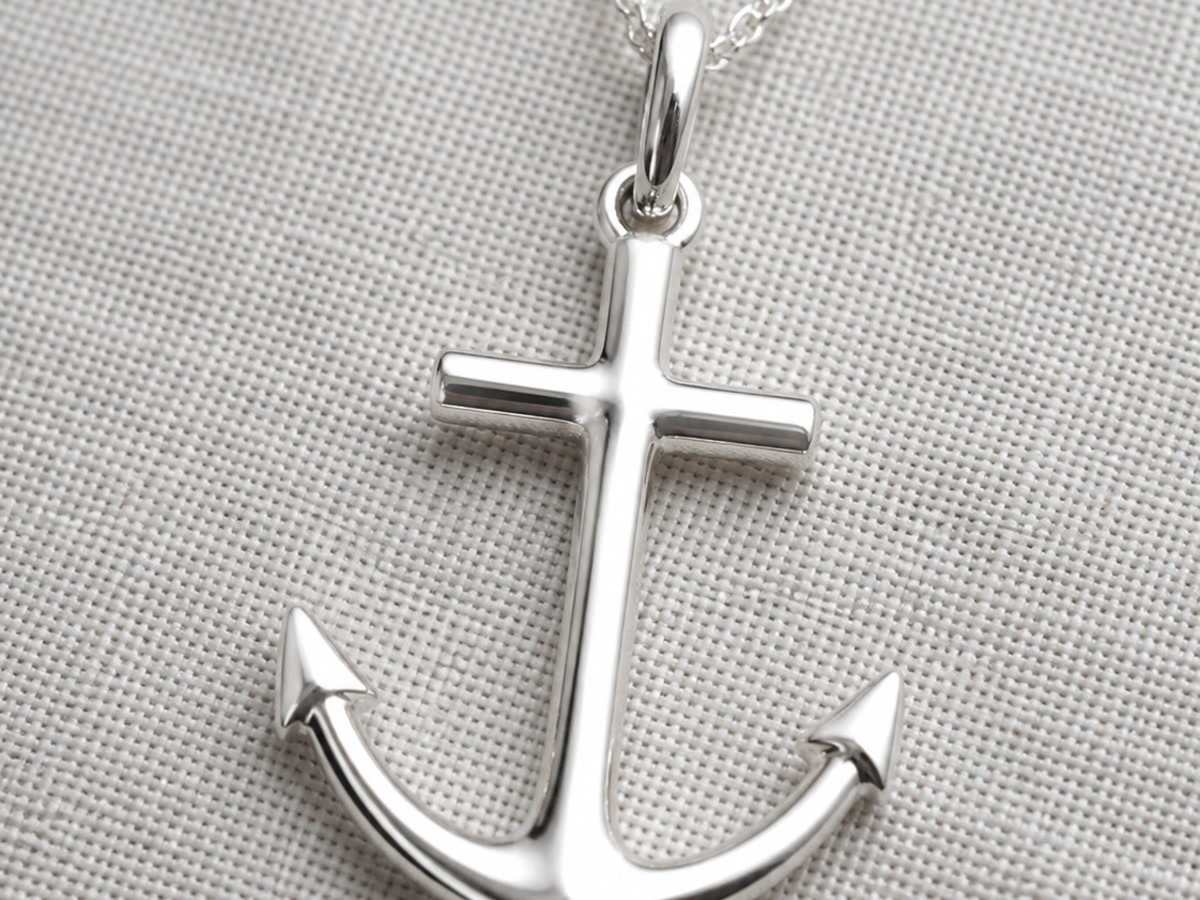
Sterling silver mariner cross pendant shaped like an anchor with curved arms, displayed on a light grey linen background

The Jerusalem Cross (Crusader’s Cross)

The Jerusalem cross consists of a large central cross surrounded by four smaller Greek crosses in each quadrant. This five-fold design has been associated with the city of Jerusalem since the Crusades of the eleventh and twelfth centuries. It became the official emblem of the Kingdom of Jerusalem after the First Crusade and remains a prominent symbol in the city to this day, appearing on the coat of arms of Israel and on the flags of various Christian organizations.

The symbolism is layered. The four smaller crosses are commonly interpreted as representing the four Gospels (Matthew, Mark, Luke, and John) emanating from Christ, or alternatively as the four corners of the earth to which the Gospel was spread. The central cross represents Christ himself. Some scholars also read the five crosses as representing the five wounds of Christ during the crucifixion.

As jewelry, the Jerusalem cross is a statement piece. Its complexity and historical weight make it instantly recognizable and deeply meaningful. It is particularly popular among people with ties to the Holy Land, those with Crusader ancestry, and anyone who appreciates the layered symbolism of the five-fold design. The Jerusalem cross translates beautifully into pendant form, especially in larger sizes where the detail of the four smaller crosses can be appreciated.

The Maltese Cross

The Maltese cross features four V-shaped arms of equal width that meet at a central point, creating an eight-pointed silhouette. It is named after the Knight Hospitaller (later the Order of Malta), who adopted it as their emblem during the Crusades. The eight points are traditionally said to represent the eight beatitudes from the Sermon on the Mount.

The Maltese cross carries a strong association with chivalry, service, and sacrifice. The Knight Hospitaller operated hospitals and provided care to sick pilgrims in the Holy Land, and their cross became a symbol of that charitable mission. Today, the Maltese cross appears on the flags of Malta, the insignia of various fire departments (particularly in the United States), and the emblem of several orders of chivalry.

In jewelry, the Maltese cross has a bold, geometric presence. The pointed arms create a dynamic shape that stands out on a chain or as an earring. It is a popular choice for people who want their cross jewelry to carry a sense of history and purpose, and it pairs well with both polished and antiqued finishes.
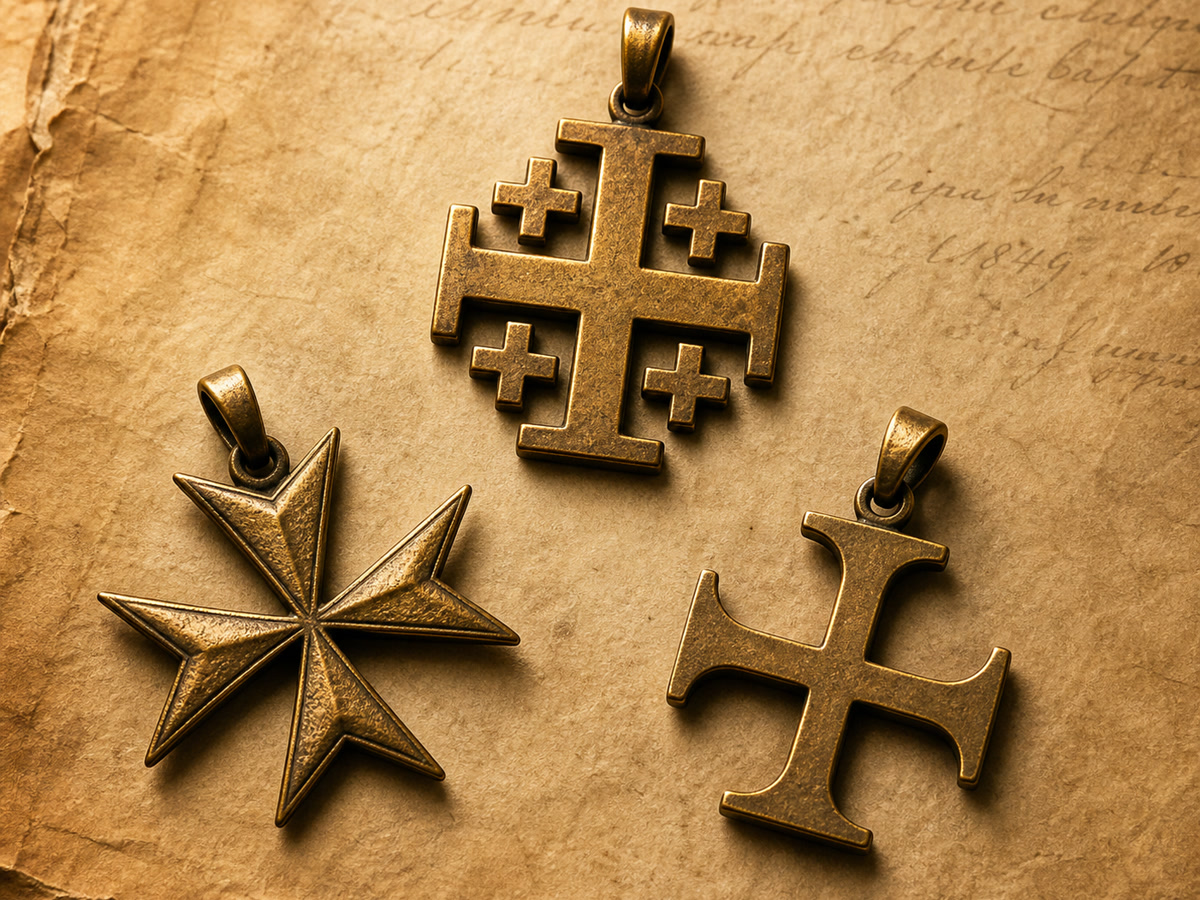
Three unique cross pendants on aged parchment: Jerusalem cross, Maltese cross, and gamma cross in antique bronze finish

The Gamma Cross (Crux Gammata)

The gamma cross, or Crux Gammata, takes its name from the Greek letter gamma, which resembles an L-shape. The four arms of the cross are formed by four gamma letters meeting at their bases, creating a design that is entirely distinct from later appropriations of similar shapes. In early Christian usage, the gamma cross was associated with the monogram of Christ, as the Greek word for Christ (Christos) begins with the letter chi, and gamma forms part of various Christogram combinations.

This cross type is most commonly found in Ethiopian Christian art and in certain Eastern traditions. The Ethiopian Orthodox Tewahedo Church uses the gamma cross extensively in its manuscripts, church decorations, and processional crosses. It carries a deep connection to one of the oldest Christian traditions in the world, as Ethiopia adopted Christianity in the fourth century.

As jewelry, the gamma cross is uncommon but striking. Its angular, symmetrical design gives it a modern, almost abstract quality that appeals to people who appreciate geometric forms. It is a conversation piece, a design that invites questions and tells a story most people have never heard.

The Cross of Lorraine (Patriarchal Cross)

The Cross of Lorraine features a vertical beam with two horizontal bars, the upper one shorter than the lower. It is also known as the patriarchal cross because it was historically used by patriarchs and archbishops as a symbol of their authority. The two-bar design predates Christianity in some interpretations, possibly originating as a symbol of rank in the Byzantine Empire.

In modern history, the Cross of Lorraine became a powerful symbol of French resistance during World War II. Charles de Gaulle and the Free French forces adopted it as their emblem, using it as a counterpoint to the Nazi swastika. This association gives the Cross of Lorraine a dual meaning: religious authority and political defiance.

As jewelry, the Cross of Lorraine has a distinctive vertical profile that works well as a pendant, especially on longer chains. The double horizontal bar adds visual interest without overwhelming the design, and the historical resonance makes it a meaningful choice for people with French heritage or an appreciation for wartime history.

The Papal Cross (Triple Cross)

The papal cross is a vertical beam with three horizontal bars of decreasing length from bottom to top. It is the official symbol of the Pope and the Holy See. The three bars are commonly interpreted as representing the three powers of the Pope: supreme temporal power, supreme spiritual power, and supreme authority. Some interpretations also connect the three bars to the Trinity.

You will see the papal cross on Vatican flags, on documents issued by the Holy See, and on papal vestments. In jewelry, it carries an unmistakable association with the Catholic Church and the authority of the papacy. It is a natural choice for devout Catholics who want their cross pendant to express not just general Christian faith but specifically Catholic identity and allegiance to the Pope.

The Botonee Cross

The botonee cross (sometimes spelled botonny) is closely related to the budded cross but with one key difference: each arm ends in a single rounded knob or trefoil rather than the three distinct lobes of the budded cross. The name comes from the French boton, meaning “button” or “bud.” In heraldic usage, the botonee cross is treated as a distinct variant, though in casual conversation the two terms are sometimes used interchangeably.

The botonee cross appears frequently in medieval European heraldry, particularly in English and French coats of arms. It carries connotations of growth, budding faith, and new beginnings. In jewelry, the rounded endings give it a softer, more organic appearance than sharper cross designs, making it a good choice for people who prefer a less angular aesthetic.

The Chi-Rho

The Chi-Rho is not technically a cross, but it belongs in any discussion of unique Christian symbols. It consists of the first two Greek letters of “Christ” (Χ and ÎĄ) overlaid on each other, creating a shape that resembles a cross with a loop at the top. The Chi-Rho was one of the earliest Christian symbols, used extensively in the fourth century after Emperor Constantine reportedly saw it in a vision before the Battle of the Milvian Bridge in 312 CE.

The symbol appears on ancient sarcophuli, early church walls, and some of the oldest surviving Christian artifacts. As jewelry, the Chi-Rho is an excellent choice for anyone drawn to the earliest period of Christian history and the symbols that predated the widespread use of the cross. Its elegant, interlocking letters create a design that is both ancient and surprisingly modern in its graphic quality.

The Cross Fleury (Flory Cross)

The cross fleury, or flory cross, features arms that end in stylized fleur-de-lis shapes. This design is deeply rooted in French heraldry and was used extensively by French royalty and nobility. The fleur-de-lis itself carries multiple symbolic meanings: purity, the Virgin Mary, and the Holy Trinity, depending on the context.

In jewelry, the cross fleury has an ornate, decorative quality that appeals to people who appreciate intricate metalwork. The fleur-de-lis endings transform a simple cross into something that feels more like a piece of art than a basic pendant. It pairs well with gold and silver settings and works as both a pendant and an earring design.

How to Choose the Right Unique Cross for You

With so many options, how do you pick? A few practical considerations can help narrow things down.

Match the Symbol to Your Story

The best cross pendant is one that connects to something real in your life. If you have Irish or Welsh heritage, the budded cross speaks directly to that lineage. If you spent time on the water or come from a family of sailors, the mariner’s cross carries personal weight. If your faith is tied to the Catholic Church and the authority of the papacy, the papal cross expresses that clearly. Choose the design that resonates, not just the one that looks the most interesting in a display case.

Consider the Visual Impact

Some of these crosses are subtle (the botonee cross, the gamma cross), while others are bold statements (the Jerusalem cross, the Maltese cross). Think about how you plan to wear the piece. A delicate budded cross works well on a thin chain for everyday wear. A large Jerusalem cross pendant makes a stronger impression and may be better suited for occasions where you want the jewelry to be noticed.

Think About Material and Finish

The material you choose affects both the look and the longevity of the piece. Sterling silver offers a classic, versatile appearance that works with virtually any cross design. Stainless steel is more durable and better for everyday wear, especially for people with active lifestyles. Gold-plated pieces add warmth and a sense of luxury. Consider how the finish complements the specific cross design: antiqued finishes work beautifully on the Maltese cross and Jerusalem cross, highlighting their historical character, while polished finishes suit the cleaner lines of the budded cross and the Cross of Lorraine.

Related Cross Guides

Want to explore more cross designs? These guides cover the history, symbolism, and jewelry options for the most popular cross types.

Frequently Asked Questions

The budded cross has three distinct lobes at the end of each arm, resembling a trefoil or shamrock shape. The botonee cross has a single rounded knob or bud at each arm ending. In heraldic contexts they are treated as separate designs, though in casual usage the terms are sometimes used interchangeably. Both carry symbolic associations with growth and the Holy Trinity.

The mariner’s cross is literally designed to look like an anchor. In early Christianity, the anchor was one of the most common secret symbols of the faith, representing hope and steadfastness (drawn from Hebrews 6:19, which calls hope “an anchor of the soul”). By merging the anchor shape with the cross, early Christians created a symbol that expressed both faith and the promise of stability. The design became especially popular in maritime communities where the anchor carried additional practical and spiritual significance.

The five crosses are most commonly interpreted as Christ (the large central cross) plus the four Gospels (the four smaller crosses), or as the four corners of the earth to which the Gospel was spread. Some scholars also read them as the five wounds of Christ during the crucifixion. The design was adopted as the emblem of the Kingdom of Jerusalem after the First Crusade and remains in use today by various Christian organizations and on the coat of arms of Israel.

No. While both are cross-shaped designs with historical military associations, they are distinct. The Maltese cross has four V-shaped arms meeting at a point, creating an eight-pointed silhouette, and originates with the Knight Hospitaller. The Iron Cross is a German military decoration with straight arms that widen toward the ends, first established in 1813. The two symbols have different origins, different histories, and different meanings. They should not be confused.

Absolutely. There is no rule that restricts which cross type a person can wear based on their denomination or background. Many people choose cross jewelry for its aesthetic appeal, its historical significance, or a personal connection to a particular tradition. If a Jerusalem cross or a Maltese cross speaks to you, wear it. The cross is ultimately a symbol of faith that transcends individual church boundaries, and jewelry is a personal expression.

Budded Cross, Mariner’s Cross & Other Unique Cross Types Explained

TL;DR – Most people know the Latin cross and the crucifix, but Christianity produced dozens of distinct cross designs, each with its own origin story and meaning. The budded cross adds trefoil endings to each arm, the mariner’s cross blends the anchor with the cross, the Jerusalem cross combines five crosses in one, and the Maltese cross carries centuries of knightly history. This guide walks through the lesser-known cross types you are likely to encounter in jewelry, art, and architecture, explains where each one came from, and helps you decide which design speaks to you.

Walk into a cathedral in Rome and you will see crosses everywhere. Walk into a jewelry store and you will see pendants that look nothing like one another. That variety is not random. Each cross shape carries a specific history, a regional identity, and a layer of meaning that goes far beyond two intersecting lines. If you have ever wondered what the little lobes on a budded cross actually represent, or why some crosses look like anchors, you are in the right place. This guide covers the cross designs that rarely make it into mainstream conversations but absolutely deserve a closer look.

Why So Many Cross Designs?

The cross is the universal symbol of Christianity, but it has never been a one-shape-fits-all design. As the faith spread across different cultures, regions, and centuries, local artisans adapted the basic cross form to reflect their own artistic traditions, theological emphases, and sometimes political alliances. A Byzantine cross looks nothing like an Irish cross, and neither resembles the crosses used by Crusader knights. These variations were not just decorative choices. They carried real meaning for the people who wore them, carved them into stone, or painted them on manuscripts.

Understanding these variations matters for anyone shopping for cross jewelry. A budded cross says something different from a Latin cross. A mariner’s cross tells a story that a plain pendant cannot. Knowing the difference helps you pick a piece that actually resonates with you, rather than settling for whatever happens to be on the shelf.

The Budded Cross (Cross Bottony)

The budded cross, also called the cross bottony or trefoil cross, features a small three-lobed ornament at the end of each arm. Those lobes are not just decoration. In Christian symbolism, the three buds on each arm represent the Holy Trinity: the Father, the Son, and the Holy Spirit. Some historians also connect the trefoil shape to the Celtic shamrock, which Saint Patrick reportedly used to explain the Trinity to Irish converts in the fifth century.

The budded cross appears prominently in heraldry and ecclesiastical architecture across England, Wales, and Ireland. You will find it carved into medieval church walls, embroidered on vestments, and stamped onto religious medals. In England, the budded cross is sometimes associated with the Church of England and appears on clergy badges and diocesan crests.

As jewelry, the budded cross offers a distinctive silhouette. The trefoil endings give it more visual weight and texture than a plain Latin cross, while still maintaining a clean, recognizable shape. It works well in both sterling silver and gold, and the lobed details catch light in a way that flat crosses do not. For anyone looking for a cross pendant that stands out without being overly ornate, the budded cross is an excellent choice.

Sterling silver budded cross pendant with trefoil endings on each arm, hanging from a delicate chain on a white marble surface

The Mariner’s Cross (Anchor Cross)

The mariner’s cross merges two of the oldest Christian symbols: the cross and the anchor. In the earliest centuries of the faith, before the cross became the dominant symbol, Christians used the anchor as a secret sign of hope. The anchor represented stability and steadfastness, drawn from the Epistle to the Hebrews, which describes hope as “an anchor of the soul.” By combining the anchor with the cross form, early Christians created a design that simultaneously expressed faith and resilience.

You will encounter the mariner’s cross most often in coastal and maritime communities. Fishing villages in Portugal, Greece, and the Caribbean feature the anchor cross on churches, grave markers, and harbor walls. It was particularly popular among sailors and seafarers who prayed for safe passage and saw the cross-anchor as a symbol of divine protection on the water.

In jewelry, the mariner’s cross has a rugged, distinctive look. The curved arms and horizontal bar create a silhouette that is immediately recognizable and quite different from standard cross pendants. It appeals to people who want their cross jewelry to carry an additional layer of meaning beyond the basic symbol, and it works particularly well in stainless steel or oxidized silver finishes that evoke a nautical aesthetic.

Sterling silver mariner cross pendant shaped like an anchor with curved arms, displayed on a light grey linen background

The Jerusalem Cross (Crusader’s Cross)

The Jerusalem cross consists of a large central cross surrounded by four smaller Greek crosses in each quadrant. This five-fold design has been associated with the city of Jerusalem since the Crusades of the eleventh and twelfth centuries. It became the official emblem of the Kingdom of Jerusalem after the First Crusade and remains a prominent symbol in the city to this day, appearing on the coat of arms of Israel and on the flags of various Christian organizations.

The symbolism is layered. The four smaller crosses are commonly interpreted as representing the four Gospels (Matthew, Mark, Luke, and John) emanating from Christ, or alternatively as the four corners of the earth to which the Gospel was spread. The central cross represents Christ himself. Some scholars also read the five crosses as representing the five wounds of Christ during the crucifixion.

As jewelry, the Jerusalem cross is a statement piece. Its complexity and historical weight make it instantly recognizable and deeply meaningful. It is particularly popular among people with ties to the Holy Land, those with Crusader ancestry, and anyone who appreciates the layered symbolism of the five-fold design. The Jerusalem cross translates beautifully into pendant form, especially in larger sizes where the detail of the four smaller crosses can be appreciated.

The Maltese Cross

The Maltese cross features four V-shaped arms of equal width that meet at a central point, creating an eight-pointed silhouette. It is named after the Knight Hospitaller (later the Order of Malta), who adopted it as their emblem during the Crusades. The eight points are traditionally said to represent the eight beatitudes from the Sermon on the Mount.

The Maltese cross carries a strong association with chivalry, service, and sacrifice. The Knight Hospitaller operated hospitals and provided care to sick pilgrims in the Holy Land, and their cross became a symbol of that charitable mission. Today, the Maltese cross appears on the flags of Malta, the insignia of various fire departments (particularly in the United States), and the emblem of several orders of chivalry.

In jewelry, the Maltese cross has a bold, geometric presence. The pointed arms create a dynamic shape that stands out on a chain or as an earring. It is a popular choice for people who want their cross jewelry to carry a sense of history and purpose, and it pairs well with both polished and antiqued finishes.

Three unique cross pendants on aged parchment: Jerusalem cross, Maltese cross, and gamma cross in antique bronze finish

The Gamma Cross (Crux Gammata)

The gamma cross, or Crux Gammata, takes its name from the Greek letter gamma, which resembles an L-shape. The four arms of the cross are formed by four gamma letters meeting at their bases, creating a design that is entirely distinct from later appropriations of similar shapes. In early Christian usage, the gamma cross was associated with the monogram of Christ, as the Greek word for Christ (Christos) begins with the letter chi, and gamma forms part of various Christogram combinations.

This cross type is most commonly found in Ethiopian Christian art and in certain Eastern traditions. The Ethiopian Orthodox Tewahedo Church uses the gamma cross extensively in its manuscripts, church decorations, and processional crosses. It carries a deep connection to one of the oldest Christian traditions in the world, as Ethiopia adopted Christianity in the fourth century.

As jewelry, the gamma cross is uncommon but striking. Its angular, symmetrical design gives it a modern, almost abstract quality that appeals to people who appreciate geometric forms. It is a conversation piece, a design that invites questions and tells a story most people have never heard.

The Cross of Lorraine (Patriarchal Cross)

The Cross of Lorraine features a vertical beam with two horizontal bars, the upper one shorter than the lower. It is also known as the patriarchal cross because it was historically used by patriarchs and archbishops as a symbol of their authority. The two-bar design predates Christianity in some interpretations, possibly originating as a symbol of rank in the Byzantine Empire.

In modern history, the Cross of Lorraine became a powerful symbol of French resistance during World War II. Charles de Gaulle and the Free French forces adopted it as their emblem, using it as a counterpoint to the Nazi swastika. This association gives the Cross of Lorraine a dual meaning: religious authority and political defiance.

As jewelry, the Cross of Lorraine has a distinctive vertical profile that works well as a pendant, especially on longer chains. The double horizontal bar adds visual interest without overwhelming the design, and the historical resonance makes it a meaningful choice for people with French heritage or an appreciation for wartime history.

The Papal Cross (Triple Cross)

The papal cross is a vertical beam with three horizontal bars of decreasing length from bottom to top. It is the official symbol of the Pope and the Holy See. The three bars are commonly interpreted as representing the three powers of the Pope: supreme temporal power, supreme spiritual power, and supreme authority. Some interpretations also connect the three bars to the Trinity.

You will see the papal cross on Vatican flags, on documents issued by the Holy See, and on papal vestments. In jewelry, it carries an unmistakable association with the Catholic Church and the authority of the papacy. It is a natural choice for devout Catholics who want their cross pendant to express not just general Christian faith but specifically Catholic identity and allegiance to the Pope.

The Botonee Cross

The botonee cross (sometimes spelled botonny) is closely related to the budded cross but with one key difference: each arm ends in a single rounded knob or trefoil rather than the three distinct lobes of the budded cross. The name comes from the French boton, meaning “button” or “bud.” In heraldic usage, the botonee cross is treated as a distinct variant, though in casual conversation the two terms are sometimes used interchangeably.

The botonee cross appears frequently in medieval European heraldry, particularly in English and French coats of arms. It carries connotations of growth, budding faith, and new beginnings. In jewelry, the rounded endings give it a softer, more organic appearance than sharper cross designs, making it a good choice for people who prefer a less angular aesthetic.

The Chi-Rho

The Chi-Rho is not technically a cross, but it belongs in any discussion of unique Christian symbols. It consists of the first two Greek letters of “Christ” (Χ and ÎĄ) overlaid on each other, creating a shape that resembles a cross with a loop at the top. The Chi-Rho was one of the earliest Christian symbols, used extensively in the fourth century after Emperor Constantine reportedly saw it in a vision before the Battle of the Milvian Bridge in 312 CE.

The symbol appears on ancient sarcophuli, early church walls, and some of the oldest surviving Christian artifacts. As jewelry, the Chi-Rho is an excellent choice for anyone drawn to the earliest period of Christian history and the symbols that predated the widespread use of the cross. Its elegant, interlocking letters create a design that is both ancient and surprisingly modern in its graphic quality.

The Cross Fleury (Flory Cross)

The cross fleury, or flory cross, features arms that end in stylized fleur-de-lis shapes. This design is deeply rooted in French heraldry and was used extensively by French royalty and nobility. The fleur-de-lis itself carries multiple symbolic meanings: purity, the Virgin Mary, and the Holy Trinity, depending on the context.

In jewelry, the cross fleury has an ornate, decorative quality that appeals to people who appreciate intricate metalwork. The fleur-de-lis endings transform a simple cross into something that feels more like a piece of art than a basic pendant. It pairs well with gold and silver settings and works as both a pendant and an earring design.

How to Choose the Right Unique Cross for You

With so many options, how do you pick? A few practical considerations can help narrow things down.

Match the Symbol to Your Story

The best cross pendant is one that connects to something real in your life. If you have Irish or Welsh heritage, the budded cross speaks directly to that lineage. If you spent time on the water or come from a family of sailors, the mariner’s cross carries personal weight. If your faith is tied to the Catholic Church and the authority of the papacy, the papal cross expresses that clearly. Choose the design that resonates, not just the one that looks the most interesting in a display case.

Consider the Visual Impact

Some of these crosses are subtle (the botonee cross, the gamma cross), while others are bold statements (the Jerusalem cross, the Maltese cross). Think about how you plan to wear the piece. A delicate budded cross works well on a thin chain for everyday wear. A large Jerusalem cross pendant makes a stronger impression and may be better suited for occasions where you want the jewelry to be noticed.

Think About Material and Finish

The material you choose affects both the look and the longevity of the piece. Sterling silver offers a classic, versatile appearance that works with virtually any cross design. Stainless steel is more durable and better for everyday wear, especially for people with active lifestyles. Gold-plated pieces add warmth and a sense of luxury. Consider how the finish complements the specific cross design: antiqued finishes work beautifully on the Maltese cross and Jerusalem cross, highlighting their historical character, while polished finishes suit the cleaner lines of the budded cross and the Cross of Lorraine.

Related Cross Guides

Want to explore more cross designs? These guides cover the history, symbolism, and jewelry options for the most popular cross types.

Frequently Asked Questions

The budded cross has three distinct lobes at the end of each arm, resembling a trefoil or shamrock shape. The botonee cross has a single rounded knob or bud at each arm ending. In heraldic contexts they are treated as separate designs, though in casual usage the terms are sometimes used interchangeably. Both carry symbolic associations with growth and the Holy Trinity.

The mariner’s cross is literally designed to look like an anchor. In early Christianity, the anchor was one of the most common secret symbols of the faith, representing hope and steadfastness (drawn from Hebrews 6:19, which calls hope “an anchor of the soul”). By merging the anchor shape with the cross, early Christians created a symbol that expressed both faith and the promise of stability. The design became especially popular in maritime communities where the anchor carried additional practical and spiritual significance.

The five crosses are most commonly interpreted as Christ (the large central cross) plus the four Gospels (the four smaller crosses), or as the four corners of the earth to which the Gospel was spread. Some scholars also read them as the five wounds of Christ during the crucifixion. The design was adopted as the emblem of the Kingdom of Jerusalem after the First Crusade and remains in use today by various Christian organizations and on the coat of arms of Israel.

No. While both are cross-shaped designs with historical military associations, they are distinct. The Maltese cross has four V-shaped arms meeting at a point, creating an eight-pointed silhouette, and originates with the Knight Hospitaller. The Iron Cross is a German military decoration with straight arms that widen toward the ends, first established in 1813. The two symbols have different origins, different histories, and different meanings. They should not be confused.

Absolutely. There is no rule that restricts which cross type a person can wear based on their denomination or background. Many people choose cross jewelry for its aesthetic appeal, its historical significance, or a personal connection to a particular tradition. If a Jerusalem cross or a Maltese cross speaks to you, wear it. The cross is ultimately a symbol of faith that transcends individual church boundaries, and jewelry is a personal expression.

Similar Posts