Stone Accents in Silver Cross Rings
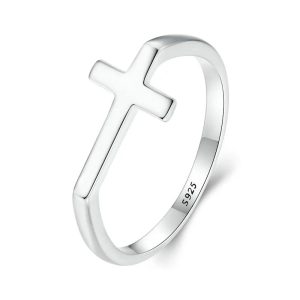
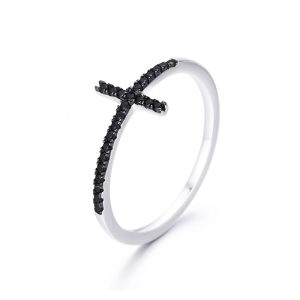
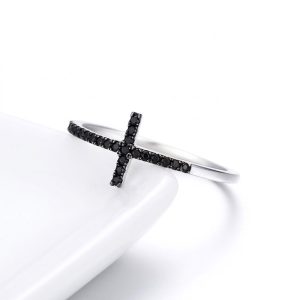
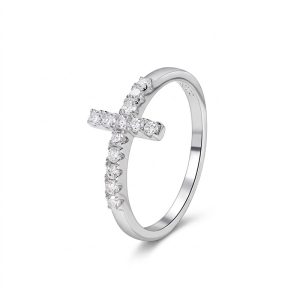
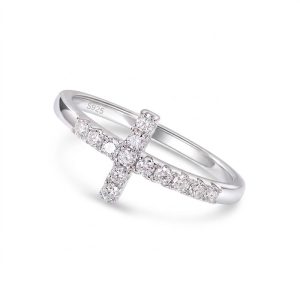
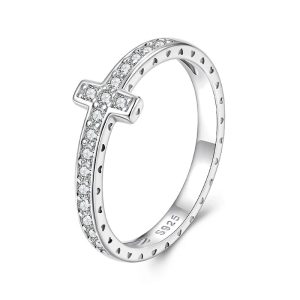
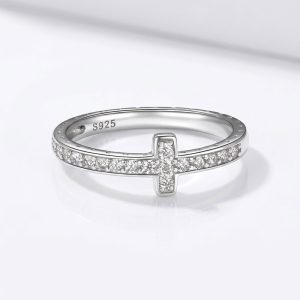
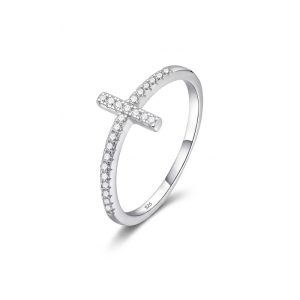
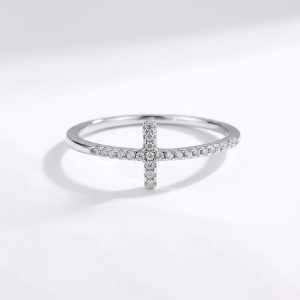
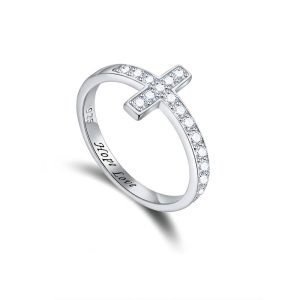
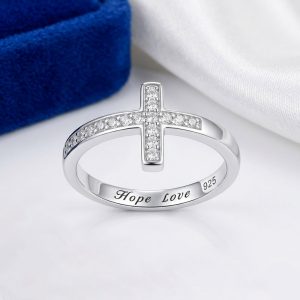
Certain designs in Crystia’s silver collection incorporate stone settings — most commonly along the cross arms or at the center intersection — and the silver finish changes how those stones read on the hand. Cool-toned metal and colorless stones occupy the same part of the visual spectrum, which means the cross form stays fully legible even with stone coverage; there is no warm-metal contrast pulling the eye away from the symbol. This visual coherence makes silver the preferred base for cross rings where stones are intended to add depth rather than drama. For those specifically looking for stone-set cross rings and wanting to understand the full range of CZ, moissanite, and lab-created options available, the diamond cross ring collection covers those distinctions in detail.
925 Sterling Silver and the Patina Question
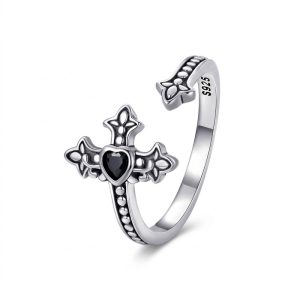
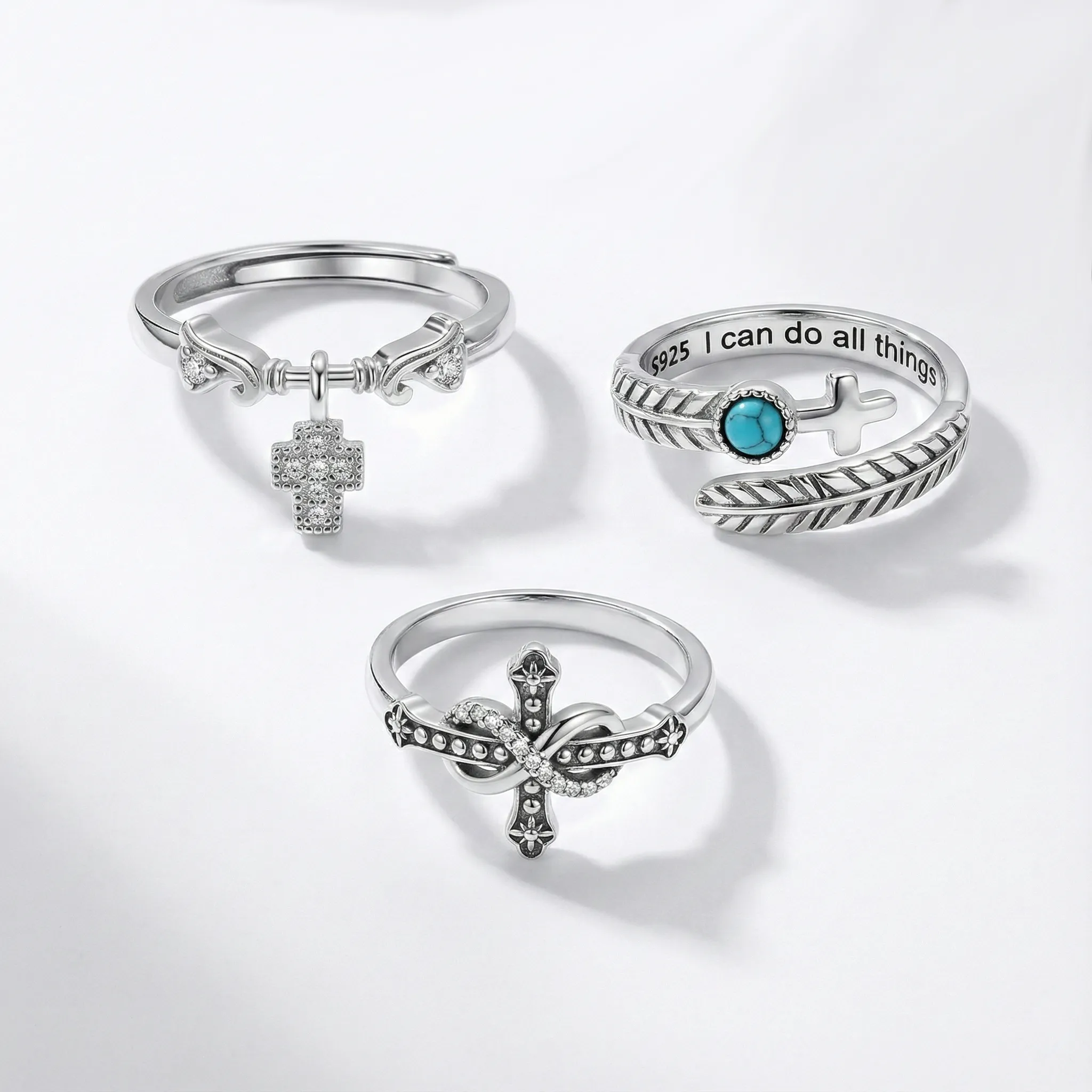
Sterling silver develops a natural patina through exposure to air, moisture, and skin chemistry — a process called tarnishing that results from silver’s reaction with sulfur compounds. For cross rings, this patina has an arguable aesthetic merit: an oxidized sterling silver cross ring develops depth and contrast as the darkened recesses of engraved or textured surfaces make the raised cross motif stand out more clearly against the darkened background. This is not a flaw in the material but a characteristic that fine silversmiths have historically exploited deliberately. Controlling the pace and character of patina development is straightforward — store sterling pieces in anti-tarnish pouches when not worn, avoid perfume and lotion contact, and clean with a polishing cloth when the surface brightness needs restoring. The cross ring with a feather-and-turquoise motif visible in some Crystia designs exemplifies this aesthetic: the oxidized detailing in the botanical elements offsets the raised silver surfaces in a way that a polished, non-patinated finish could not achieve.
Adjustable and Fixed-Band Formats
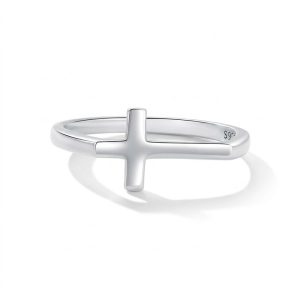
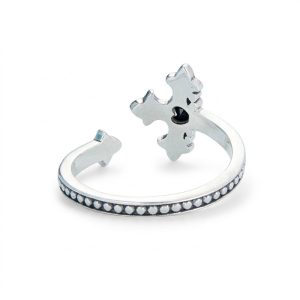
Silver cross rings at Crystia divide into two structural categories that serve different practical purposes. Adjustable open-band designs — typically with the cross set at the center of the band’s opening — accommodate finger sizes 5 through 9 without resizing, making them the default format for gifting when the recipient’s exact size is unknown. The open-band construction also allows the ring to be worn at different points on the finger with slight adjustment, which is a functional advantage for wearers whose finger size fluctuates with temperature or activity. Fixed-band designs offer better structural security for heavier stone settings, as the complete band provides more uniform support for the ring’s face; scripture-engraved bands in particular are better served by a fixed construction because the engraving runs around the full circumference and a break in the band interrupts the text. Both formats are represented in Crystia’s silver category.
The Crystia Quality Commitment
Every silver cross ring in Crystia’s collection is evaluated against consistent finishing standards before it reaches the customer: stone settings inspected for prong security and seating consistency, band edges finished smooth against the skin, and oxidized surface treatments applied with the controlled depth that distinguishes intentional patina work from uneven aging. Sterling silver pieces are selected from artisans who work at the precision required by small-scale engraving and stone setting — categories where tolerances are tight and inconsistency shows immediately. The goal across the collection is a ring that maintains its design integrity through daily wear, not just on the day it arrives.