CZ, Moissanite, Lab Diamond: Understanding the Distinctions
The three stone types in Crystia’s diamond cross ring collection serve different buyer priorities and should not be treated as interchangeable. Cubic zirconia is the accessible entry point: visually clean, consistently colorless, and available in standardized cuts that produce predictable brilliance across the cross face. At AAAAA grade, CZ is virtually indistinguishable from diamond to the naked eye in normal lighting conditions, which is why pavé CZ cross rings have dominated the stone-set faith jewelry market since the 1990s. Moissanite addresses buyers who want measurably superior stone performance — its dispersion rating of 0.104 (versus diamond’s 0.044) produces a “fire” that reads as richer and more colorful than diamond in the same light, making a moissanite cross ring visually active even in low-light settings. Lab-created diamonds — grown through CVD (Chemical Vapor Deposition) or HPHT (High Pressure High Temperature) processes — are chemically and physically identical to mined diamonds, carrying the same 10 Mohs hardness and 2.42 refractive index, but produced without the environmental cost of extraction. For buyers who want the category accuracy of genuine diamond in their cross ring, lab-created is the technically correct choice; for buyers who prioritize visual impact over material certification, moissanite typically outperforms lab diamond at equivalent price points.
Setting Styles and What They Do to the Cross
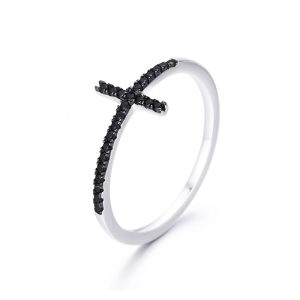
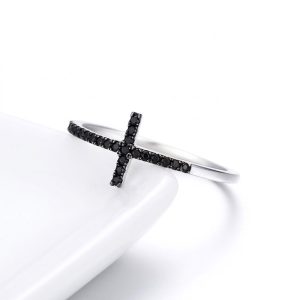
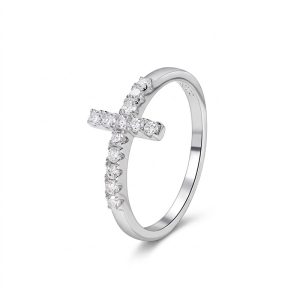
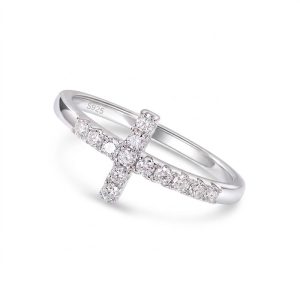
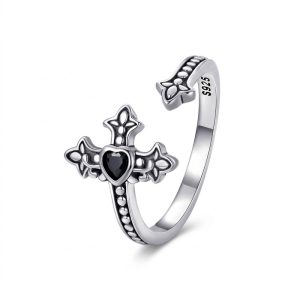
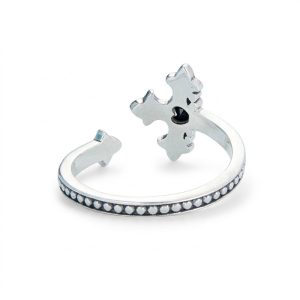
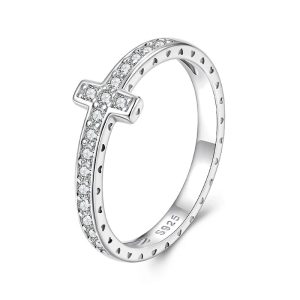
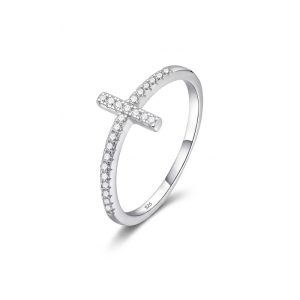
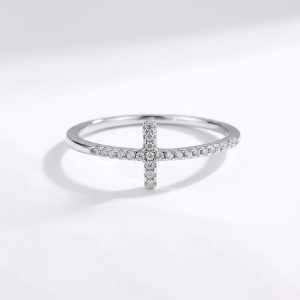
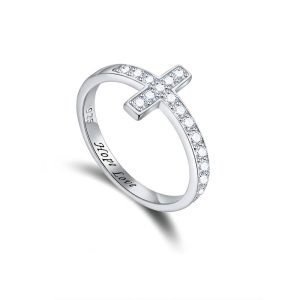
How stones are positioned in a cross ring determines the visual character of the entire piece. Pavé settings — small stones set flush across the surface of the cross arms with minimal metal showing between them — maximize stone coverage and produce the most uniform brilliance across the symbol’s face. This is the most common configuration in Crystia’s diamond cross ring collection, and it works across both gold and silver finishes without favoring either. Channel settings run stones in a single line, typically down the vertical arm or across both arms of the cross, producing a cleaner graphic effect that reads more architectural than decorative. Prong-set solitaire placements at the center intersection of the cross — where the arms meet — direct the eye immediately to the symbolic core of the piece; this configuration makes the most sense for larger stones where the individual gem’s quality is the primary selling point. Open-band designs with a stone-set cross face floating at the opening combine the sparkle of a set cross with the adjustable sizing advantage of a split band, a practical choice for pieces intended as gifts.
Stacking Diamond Cross Rings
Stone-set cross rings stack differently from plain metal bands. The raised profile of a pavé cross face creates a height differential that needs to be accounted for when placing adjacent rings — a flat metal band on either side sits below the cross face and creates natural framing, while another pavé or raised band creates a competing visual field. The most successful stacks treat the diamond cross ring as the deliberate focal point and keep flanking pieces simple: a thin polished band in matching metal, a plain twisted-wire band, or a plain dome ring at lower height. For wearers who want to pair a diamond cross ring with an engagement ring or wedding band, placing the cross ring on the middle or index finger removes the stacking question entirely while keeping both pieces simultaneously visible.
The Crystia Quality Commitment
Stone-set rings demand higher production precision than plain metal bands — the tolerances for prong height, pavé spacing, and channel wall consistency are tighter, and any inconsistency in stone seating is immediately visible in reflected light. Crystia selects artisans for the diamond cross ring collection against these specific standards: even stone spacing verified under magnification, prong tips finished to prevent fabric snagging, and setting depths calibrated to secure the stone without obscuring its table facet. Ring bases are inspected for band-edge smoothness and plating uniformity before stones are set, ensuring the finished piece performs as a complete system rather than a stone placed on an unreviewed substrate.