Why Choose a Crucifix Necklace?
Few jewelry choices communicate as clearly as a crucifix worn against the chest. Beyond its theological function, the choice of material determines how that piece performs over years of daily contact with skin.
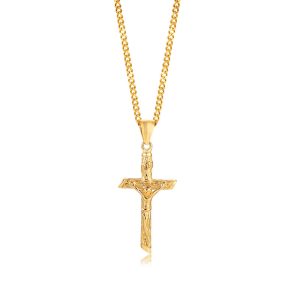
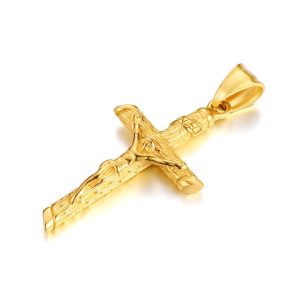
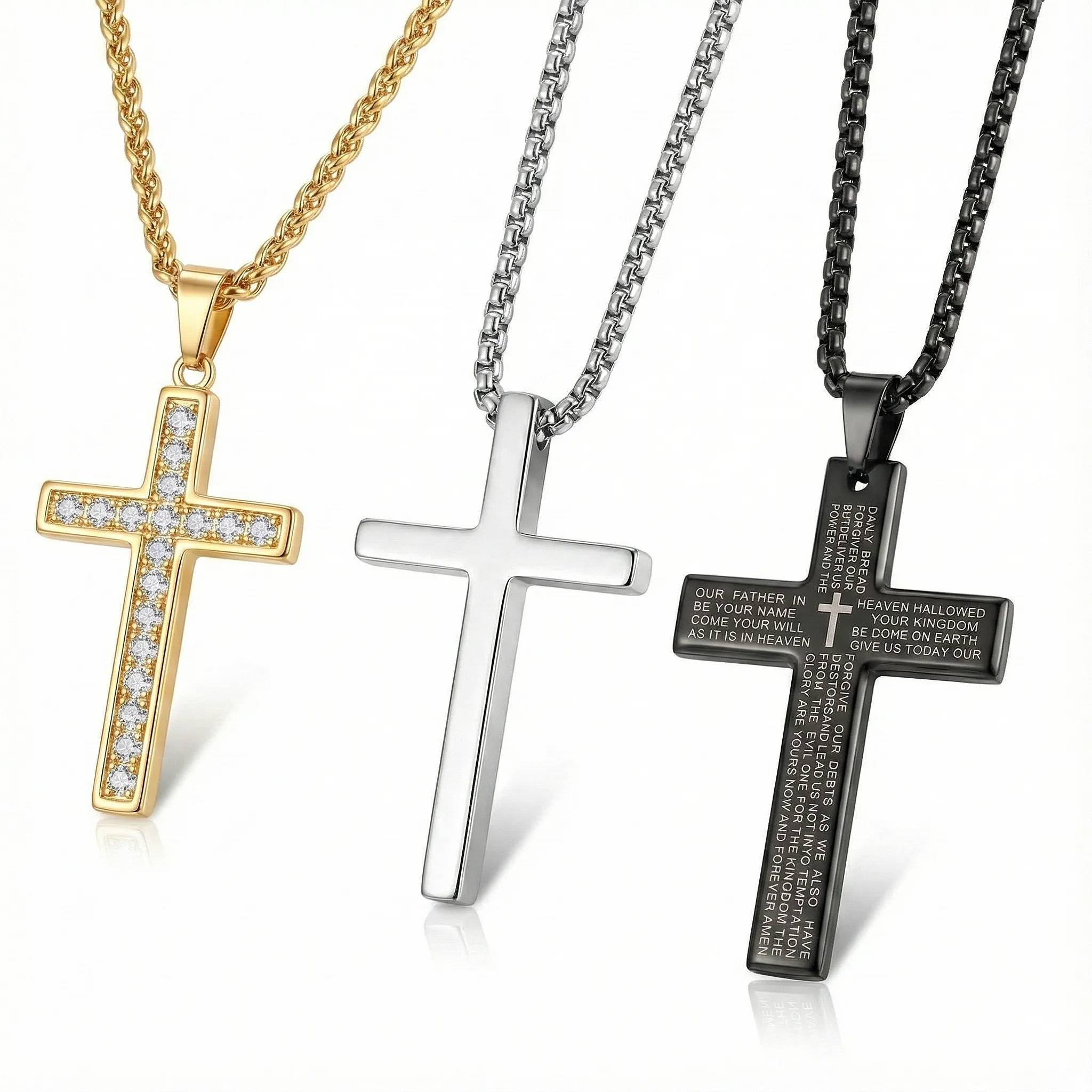
316L surgical-grade stainless steel is the most durable base for crucifix pendants: non-porous, fully hypoallergenic, and resistant to tarnishing even with daily exposure to water, sweat, and product residue. Sterling silver 925 (an alloy of 92.5% pure silver) delivers the cold, bright finish associated with traditional devotional jewelry, though it benefits from occasional polishing to maintain its sheen. For those who prefer warmth and luster, Crystia offers pendants in 14K and 18K gold plating over a stainless or sterling core, with plating thickness calibrated for multi-year wear rather than seasonal fashion. Wooden crucifix pendants occupy a different register entirely: carved from olive or rosewood, they carry an organic, tactile quality rooted in Franciscan and monastic tradition. Chain lengths typically run 20″ to 24″ for men and 18″ to 20″ for women, paired with lobster claw clasps for secure, daily-wear reliability.
The Corpus in Detail: What to Look for in a Crucifix Pendant
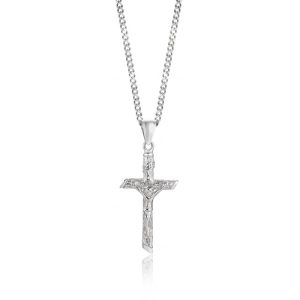
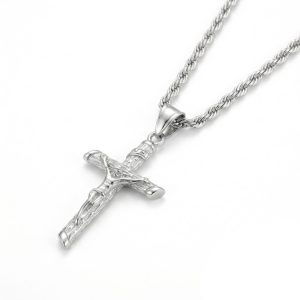
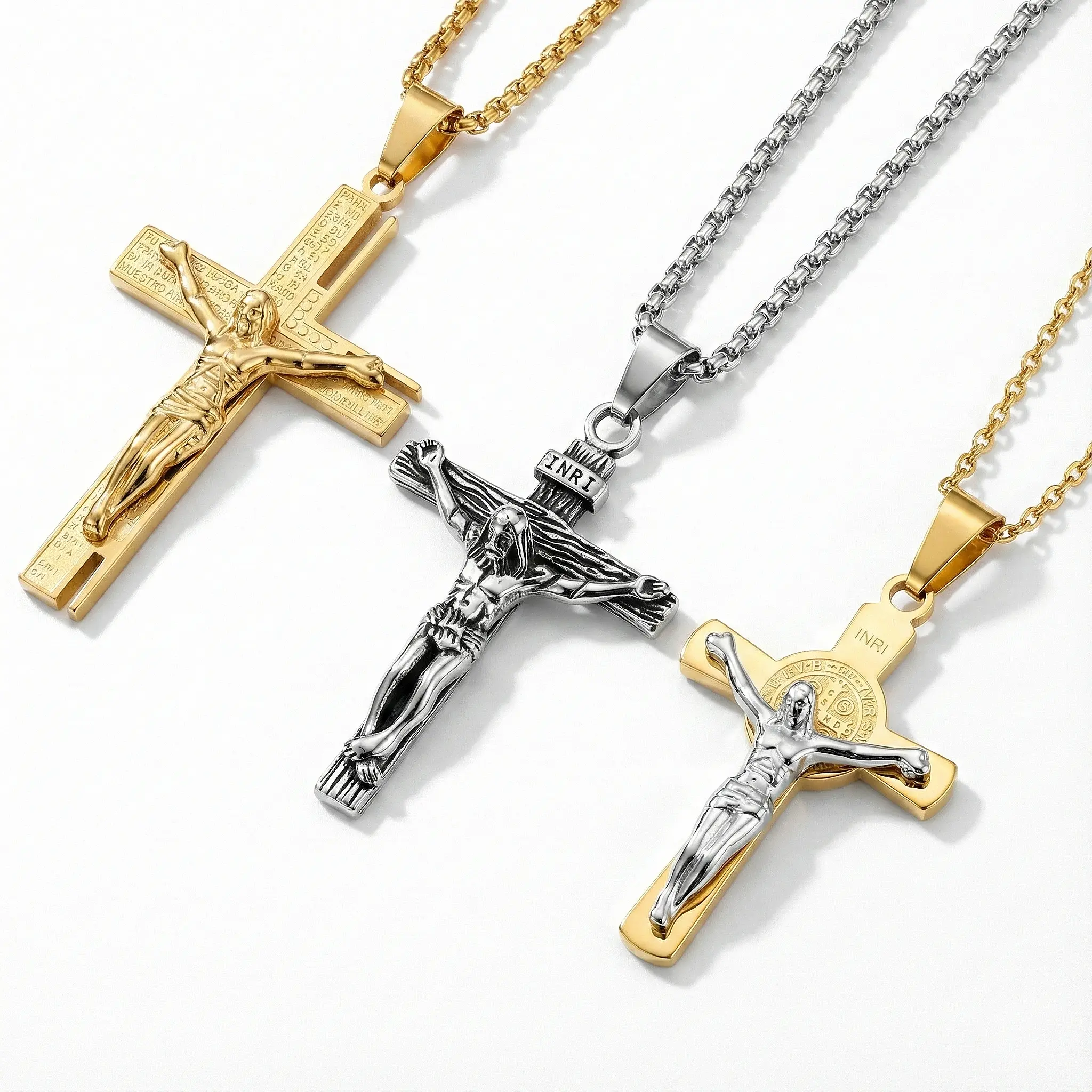
The quality of a crucifix pendant is read in its corpus. A well-executed figure shows clear anatomical structure — defined torso, extended arms, crossed feet — with facial features that are intentional rather than blurred by over-casting. The INRI titulus should be legible, not merely decorative. On higher-finish pieces, the corpus is cast separately and then applied to the cross, allowing for deeper relief and sharper definition than a single flat-stamped design. This distinction in construction is immediately apparent when two pendants are placed side by side, and it’s the benchmark Crystia applies during sourcing.
The Saint Benedict Crucifix
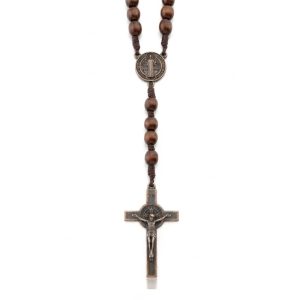
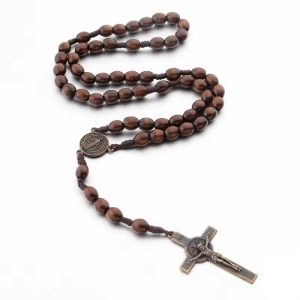
One of the most requested variants in Catholic devotional jewelry is the Saint Benedict crucifix, which pairs the corpus with the Benedictine medal on the reverse face. That medal encodes a Latin exorcism prayer in abbreviated form and has been considered a powerful sacramental in Catholic tradition since its formal recognition in the 11th century. This version is particularly common as a baptism or confirmation gift and is among the most doctrinally layered pieces in any crucifix collection.
Large-Scale vs. Refined Crucifix Pendants
Pendant size carries its own visual language. A bold, oversized crucifix — 2″ or more in height — makes an unmistakable declaration of faith and reads strongly over heavier chains or layered outfits. A smaller, refined corpus on a fine rolo or box chain sits closer to the skin and functions as a personal devotional piece rather than a public statement. Both are legitimate expressions of the same conviction; the distinction is between visibility and intimacy, not between faith and fashion.
Occasions, Gifting, and Daily Devotion
Crucifix necklaces are among the most commonly given faith gifts in the United States. First Communion, Confirmation, Baptism, and Easter remain peak gifting moments, though the crucifix has become a fixture of everyday devotional wear for adults who carry their faith as a daily practice. For those who already layer jewelry, a crucifix pendant pairs naturally with plain chain necklaces worn at a different length, creating visual depth without competition.
Crystia’s Commitment to Quality
Every crucifix pendant in Crystia’s collection is selected through a sourcing process that prioritizes structural integrity, finish durability, and theological accuracy in the corpus rendering. Artisan partners are evaluated on casting consistency, clasp reliability, and their capacity to maintain corpus detail at scale. The result is a line of crucifix necklaces that wear as devotional objects should: without premature degradation, without skin reactions, and without the visual decline that undercuts the meaning of what you’re wearing.