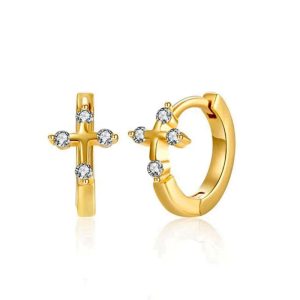
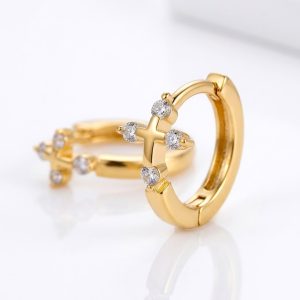
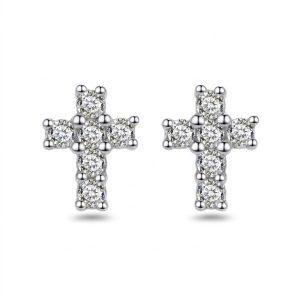
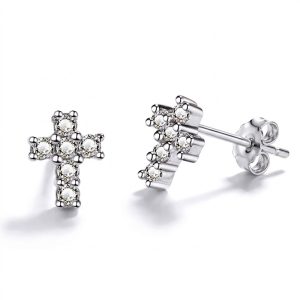
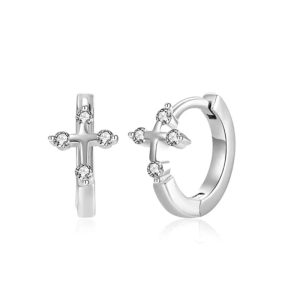
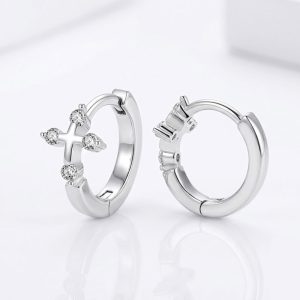
Cubic zirconia (CZ) is the dominant stone in the accessible price segment of stone-set cross jewelry and is a far more technically capable material than its reputation suggests. Synthesized zirconium dioxide, CZ has a refractive index of 2.15 to 2.18, slightly above diamond’s 2.42, which means it disperses light aggressively and produces visible fire even in small diameters. At cut quality levels consistent with jewelry-grade production, round-cut CZ stones under 3mm, the size most commonly used in pavé cross settings, are functionally indistinguishable from diamond by casual observation at conversational distance. The tradeoff is hardness: CZ rates 8 to 8.5 on the Mohs scale versus diamond’s 10, which means it will develop surface micro-scratches over years of contact wear that diamond resists entirely.
Moissanite occupies a distinct position above CZ and below natural diamond in both performance and price. Originally discovered in meteorite samples by Henri Moissan in 1893, modern moissanite is entirely lab-grown as silicon carbide (SiC) and rates 9.25 on the Mohs scale, making it the second-hardest gemstone material in commercial use. Its refractive index of 2.65 to 2.69 actually exceeds diamond, which gives moissanite a fire and brilliance that reads as optically richer than diamond in certain lighting conditions. For cross earrings in the statement or occasion tier, moissanite delivers fine jewelry performance at a fraction of natural diamond cost without any ethical sourcing complexity.
Lab-created diamonds are chemically and physically identical to earth-mined diamonds, CVD or HPHT-grown carbon at 10 Mohs hardness with the identical refractive index, thermal conductivity, and crystal structure as natural stones. In cross earring settings, lab-created diamonds provide the definitive answer to the question of stone quality: what sits in the setting is diamond, with a gemological certificate to confirm it, produced without the environmental or ethical concerns associated with mining. Posts and findings in Crystia’s lab-created diamond cross earrings are set in 925 sterling silver or 316L stainless steel with rhodium plating where specified, ensuring the setting quality matches the stone quality throughout the piece.
Setting Styles and How They Shape the Light
The method by which stones are held in a cross earring determines as much about the visual result as the stones themselves.
Pavé: Continuous Light Across the Surface
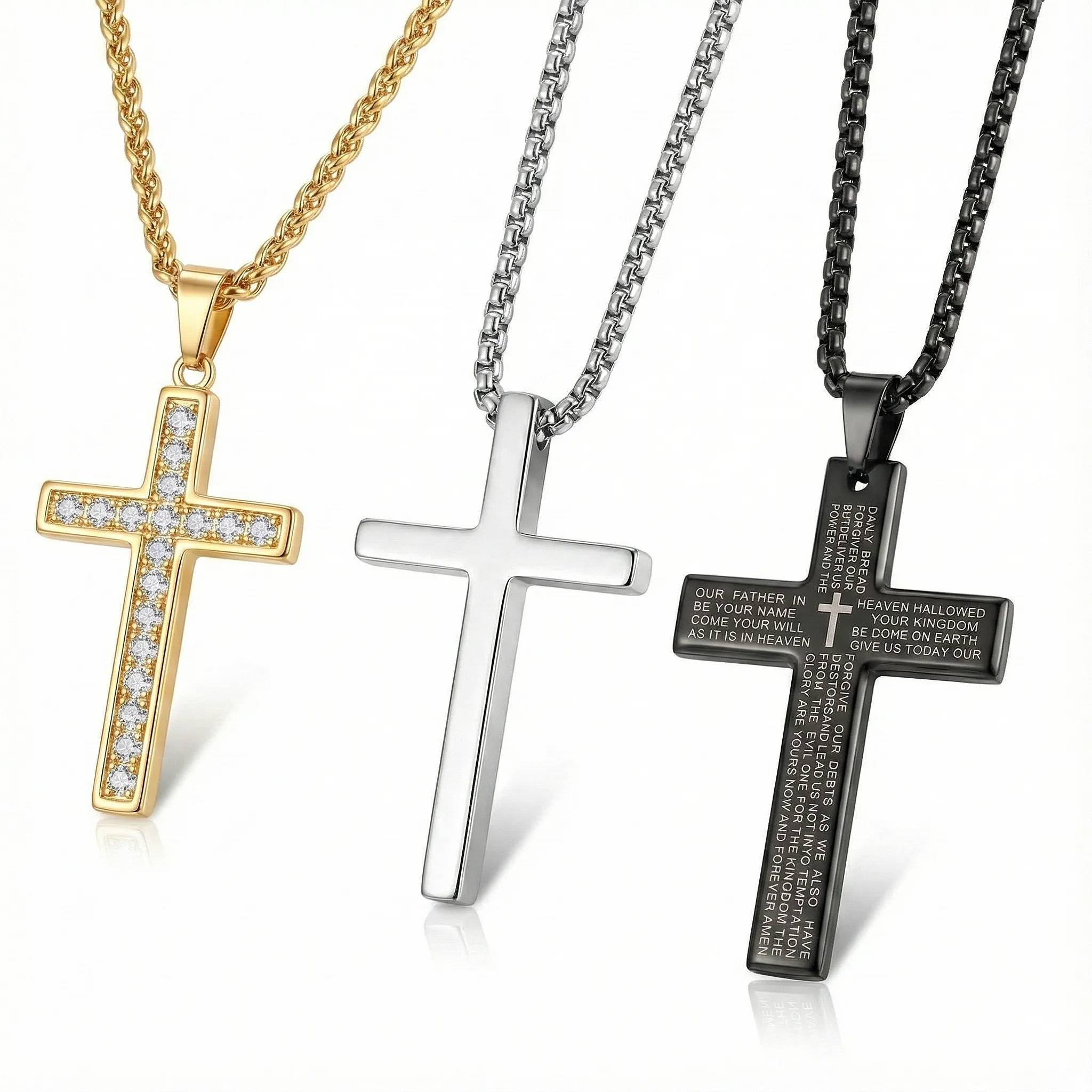
A pavé-set cross covers the entire surface of the cross arms with closely spaced stones held by minimal metal beads, leaving the stones nearly touching with almost no metal visible between them. At the scale of a cross earring, this creates a surface that functions as a single continuous reflector rather than a collection of individual points, producing a uniform brightness that reads as bold and decisive at face level. The technique requires precision in stone sizing and setting to maintain the even spacing that makes the surface coherent, and the quality of this execution is one of the clearest indicators of overall craftsmanship in a stone-set cross earring.
Prong Setting: Individual Brilliance, Maximum Light Entry
Prong-set stones, held by small claws at each girdle edge, allow light to enter the stone from below as well as above, which is the condition that maximizes a stone’s optical performance. A cross earring with individually prong-set stones shows each stone’s fire and brilliance as a distinct event rather than part of a continuous surface, which creates a more dynamic visual effect as the piece moves. This setting style suits larger stones and designs where the stone is the primary visual element rather than a surface treatment.
Bezel Setting: Security and a Cleaner Profile
A bezel-set stone is encircled by a thin wall of metal that holds it completely around its circumference. This is the most secure setting available, particularly relevant for earrings worn through active daily schedules where contact and abrasion are constant. Bezel settings also create a cleaner, more contained visual profile that suits wearers who want the stone to read as a deliberate accent rather than a dominant element.
Scale and Format: Stone-Set Crosses Across Silhouettes
Stone-set designs behave differently across the three primary cross earring formats, and the right format depends more on occasion and lifestyle than on personal preference alone.
For daily wear, a pavé-set cross stud at 8 to 10mm across the arms in a 316L stainless or sterling silver setting provides all the visual presence of a stone-set piece within a profile compact enough for any environment. The stones add light without adding mass or movement, making this the most practical stone-set format for women and men who wear their earrings from morning through evening without changing.
For occasions that call for more, a drop pendant in pavé-set CZ or moissanite suspended from a small hoop finding introduces both the movement that amplifies stone performance and the vertical length that engages the jaw and neck. The combination of a swinging cross with a fully stone-covered surface produces a light-scattering effect that is not available in any fixed format at any price point.
The hoop cross with an integrated stone-set cross element is the format that bridges everyday and occasion wear most naturally. The cross reads from across a room but sits close enough to the ear to work in a restrained wardrobe without demanding attention.
For Men: Stone-Set Cross Earrings With a Different Design Logic
Stone-set cross earrings for men in the American market have followed a clear and consistent design direction: stones are used for brightness and dimension rather than decoration, applied in clean geometric arrangements across proportions heavy enough to read as intentional masculine jewelry. A square-arm cross with full pavé coverage in a 14mm stud format communicates differently than the same stones in a delicate drop, and the men’s range within this collection was designed with that distinction in mind. Single-ear styling with a stone-set cross at the lobe against a plain stud in a second piercing is one of the most current expressions of this format in American men’s jewelry.