Motion as a Design Principle
A cross pendant that hangs freely does not behave the same way in all contexts. In stillness, it aligns vertically with gravity and presents its full front face to the viewer. In movement, it rotates and tilts on its jump ring, catching ambient light differently at each angle and making the piece visually dynamic in a way that static jewelry cannot replicate. This is not incidental; it is the primary reason to choose a dangle cross over another format. The movement is the point.
Finding Types and What They Change
The finding connecting the cross to the ear determines everything about how the pendant moves and how the overall piece reads at the ear.
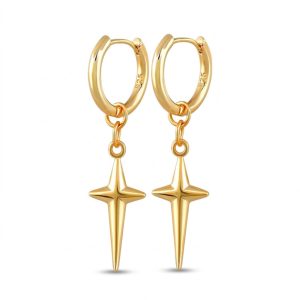
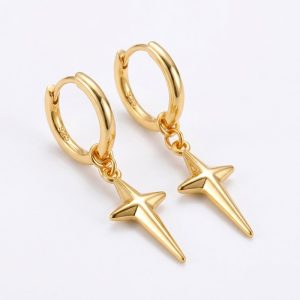
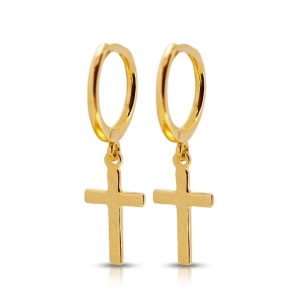
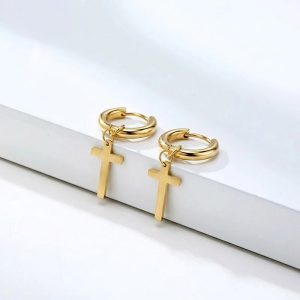
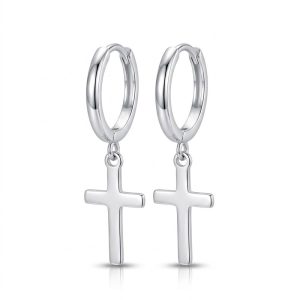
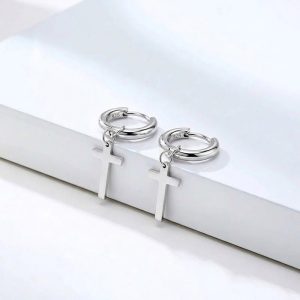
A small hinged hoop, sometimes called a huggie, keeps the cross pendant close to the head and slightly contained in its movement. The cross swings within a narrow radius, producing subtle motion without extending far below the jaw. This is the most versatile finding for dangle cross earrings because it reads proportionately across a wide range of contexts and works equally well in a first or second ear piercing.
A larger snap-close hoop introduces more distance between the ear and the pendant, adding swing range and visual length. The cross sits lower, the connection between hoop and pendant is more visible as a design element, and the overall piece makes a more deliberate statement than the huggie version.
A shepherd’s hook or leverback wire finding gives the most freedom of movement, as the pendant hangs from a curved wire that sits lightly in the piercing. This finding is the most delicate-looking and the most suited to formal or occasion wear, where the cross moves freely against the neck and jaw and creates the most visible interaction with light.
Drop Length and How the Cross Frames the Face
Total drop from the base of the earlobe to the bottom of the pendant cross ranges across the collection from approximately 18mm on the more contained end to 45mm on the longer styles. The practical consequence of this range is how the cross sits in relation to the jaw and the neckline.
A drop of 18 to 25mm places the bottom of the cross at or just below the jaw, framing the lower face without extending into the neck. This length works cleanly with shorter hairstyles and high necklines because the cross remains visible and does not disappear behind a collar. A drop of 30 to 45mm extends the cross well below the jaw and into the upper neck zone, where it interacts visually with any necklace being worn at the same time. At this length, coordinating the metal finish of the earring with whatever sits at the collarbone becomes more relevant because both pieces occupy the same visual field.
Stone and Surface: What Hangs From the Finding
The cross pendant itself varies across the collection in surface treatment and stone content in ways that shift both the visual weight and the occasion range of the piece.
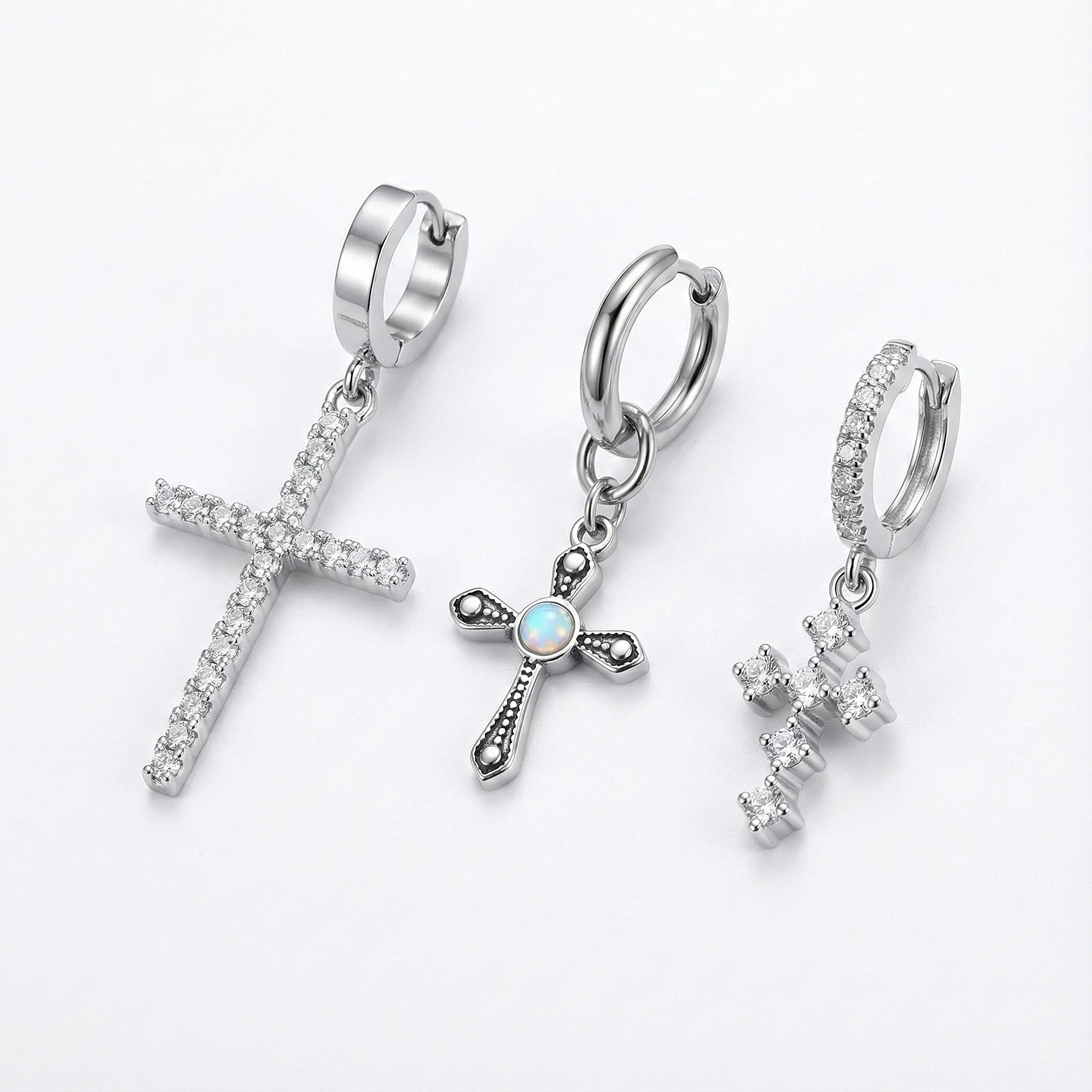
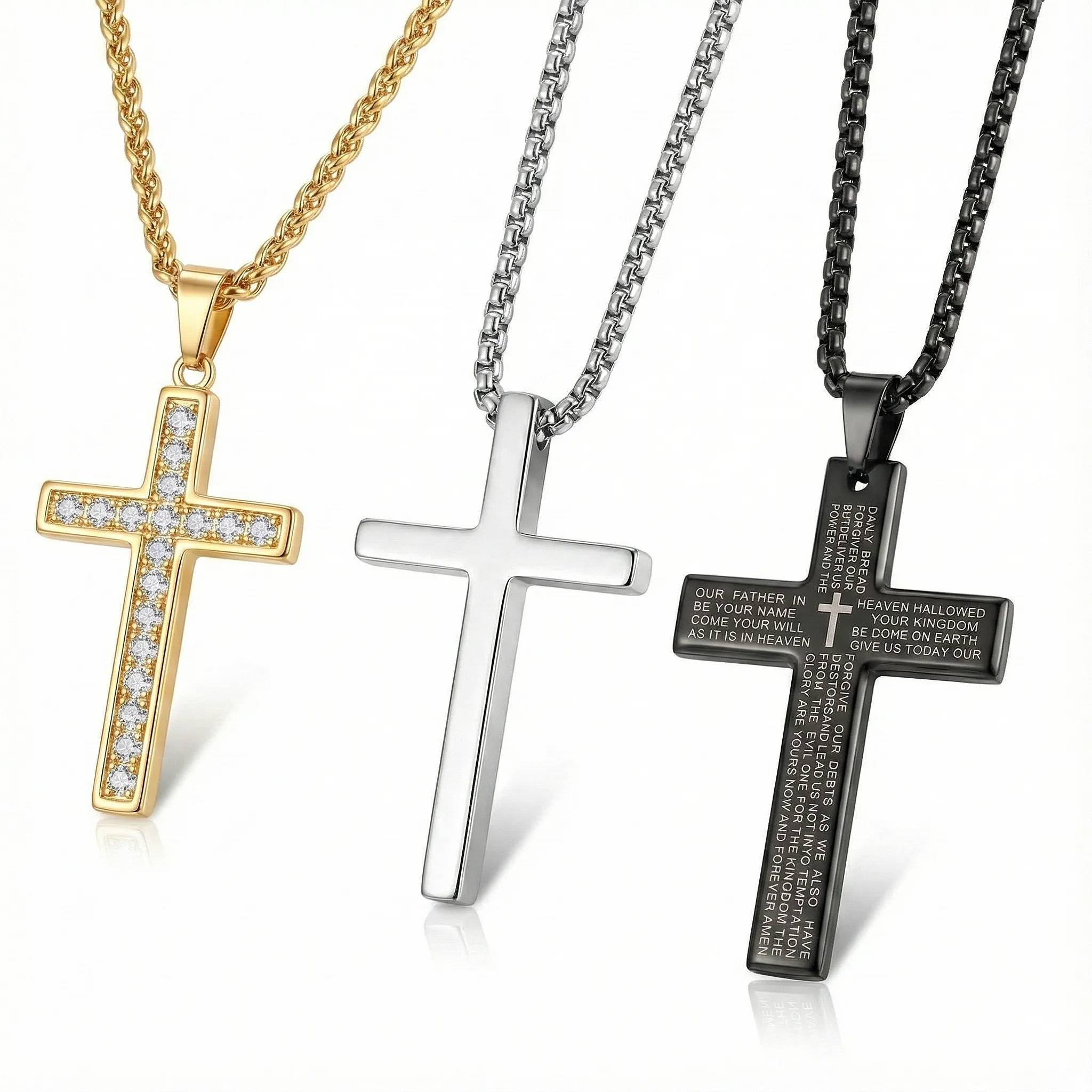
Plain polished crosses in a single metal tone are the most architectural option. The surface reads as a clean plane, the light reflects uniformly, and the symbol’s geometry is uninterrupted. These pairs work at any hour of the day and in contexts where restraint is appropriate.
Pavé-set crosses, where small cubic zirconia stones are set in closely spaced metal beads across the entire surface of the pendant, produce a continuous brightness that amplifies the natural motion of the dangle. Each stone rotates into and out of direct light as the pendant swings, creating a scattered brilliance effect that a flat metal surface cannot approach. This is the dominant finish in occasion-wear dangle crosses because it performs under the low, artificial lighting of evening events in a way that polished metal alone does not.
Accent stone designs place a single larger stone at the center of the cross intersection, a construction with clear devotional precedent: centered stones at the crossing point echo the formal decorative language of ecclesiastical jewelry across multiple traditions. An opal or moonstone at this position introduces color variation and a soft, shifting iridescence that distinguishes the piece from standard clear-stone designs. These crosses pair well with both silver-toned and gold-toned gold cross earrings styles depending on the metal of the setting, and they suit wearers who want something with visual specificity rather than the uniformity of an all-pavé design.
Occasion Range: From First Light to Last Toast
The practical advantage of dangle cross earrings over fixed formats is their ability to occupy a wider range of occasions without requiring the wearer to own multiple different pieces.
For morning and daytime wear, a small huggie-finding dangle in plain silver or gold tone sits quietly enough to clear a professional environment while still communicating intention. The movement is subtle at that scale, and the cross reads as jewelry first, symbol second, in a way that rarely prompts comment in a work setting.
For Sunday services, holiday gatherings, and occasions with an explicitly devotional context, a longer drop with stone-set cross becomes appropriate in a way it might not be at a desk. The full visual presence of the piece, its movement at the jaw, the light behavior of a pavé surface, all of these are suited to spaces and moments where a person wants their faith visible and their appearance considered.
For evening events, the longest drops with the most light-active stone settings perform exactly as occasion jewelry should: they participate in the ambient energy of the room, catch candlelight or warm interior lighting, and make the wearer’s presence felt without any additional effort on her part.