Closure Types and What They Mean for Fit
The closure on a beaded bracelet is not a minor detail — it determines who can wear it, how long it lasts, and how the bracelet behaves on the wrist.
Adjustable macramé knot closures, made from waxed cotton or nylon cord, allow the circumference to be reduced or expanded across a range of several inches by sliding the knot. This makes them the most practical format for gifting when wrist size is unknown, and the most versatile for children whose wrists change over time. The cord itself is typically water-resistant and maintains its knot tension through normal activity.
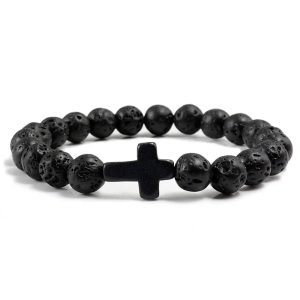
Elastic cord strands — the most common format in natural stone beaded bracelets — offer a one-size-fits-most convenience with no clasp to manipulate. The elastic base allows the strand to stretch over the hand and settle snugly on the wrist. Quality elastic cores in well-constructed beaded bracelets use a multi-strand configuration that distributes tension evenly across the cord, reducing the risk of snap failure at a single stress point. Over time, elastic does fatigue; a well-made beaded bracelet can be restrung if needed.
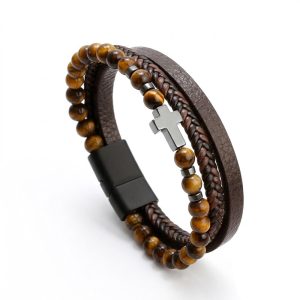
Lobster-claw clasps on beaded strands trade the casual simplicity of stretch cord for a more secure, jewelry-grade closure. These are typically found on finer bead formats — freshwater pearl strands, cultured pearl designs, or high-quality stone strands where the individual bead cost justifies a more permanent construction. The clasp allows the strand to lie flat without the slight raised join that a knot closure creates, resulting in a cleaner profile on the wrist.
The Stone Speaks: Natural Materials and Their Devotional Associations
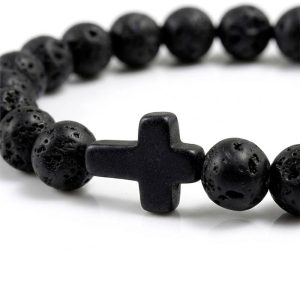
Natural stone has been assigned spiritual meaning across virtually every religious tradition, and many of the stones that appear in beaded cross bracelets carry associations that predate Christianity itself. Onyx has been connected to strength and grounding in multiple traditions; lava stone, with its porous volcanic surface, is associated with courage and stability and is also used as a diffuser base for essential oils. Turquoise, one of the oldest gemstones in human adornment history, appears across Native American, Persian, and early Christian devotional objects alike.
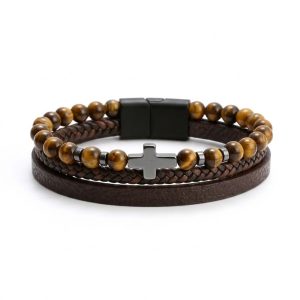
In the context of a cross bracelet, these associations layer onto the central symbol rather than competing with it. A matte onyx strand with a stainless steel cross worn by a man who values both his faith and the tactile grounding of natural material is not experiencing a contradiction — he is participating in a long tradition of combining the sacred and the elemental on the same piece.
Freshwater and cultured pearl strands carry a different resonance: purity, softness, and ceremonial significance that makes them particularly well-suited to first communion gifts, confirmation presents, and baptism jewelry for children. The pearl’s organic origin — built up in nacre layers within a living shell — gives it a warmth and depth that no synthetic material replicates, and a cross suspended from or centered within a pearl strand reads as both modest and significant.
For Every Wrist: Children, Women, Men
Beaded cross bracelets are among the few jewelry formats that scale naturally across all ages and both genders without requiring design concessions. Children’s styles typically run from 5.5″ to 6″, achievable with elastic cord or adjustable knot closures that grow with the child. Women’s styles occupy the 6.5″ to 7.5″ range in similar constructions, while men’s versions use larger-diameter beads — 10mm to 12mm rather than the 6mm to 8mm standard in women’s and children’s designs — and heavier cross elements that maintain visual proportion on a broader wrist.
The adjustable macramé format is the most gift-friendly across all three audiences: a single bracelet with a sliding closure can fit a child’s wrist at confirmation and still sit correctly on an adult wrist years later, accumulating meaning as it stretches across time.